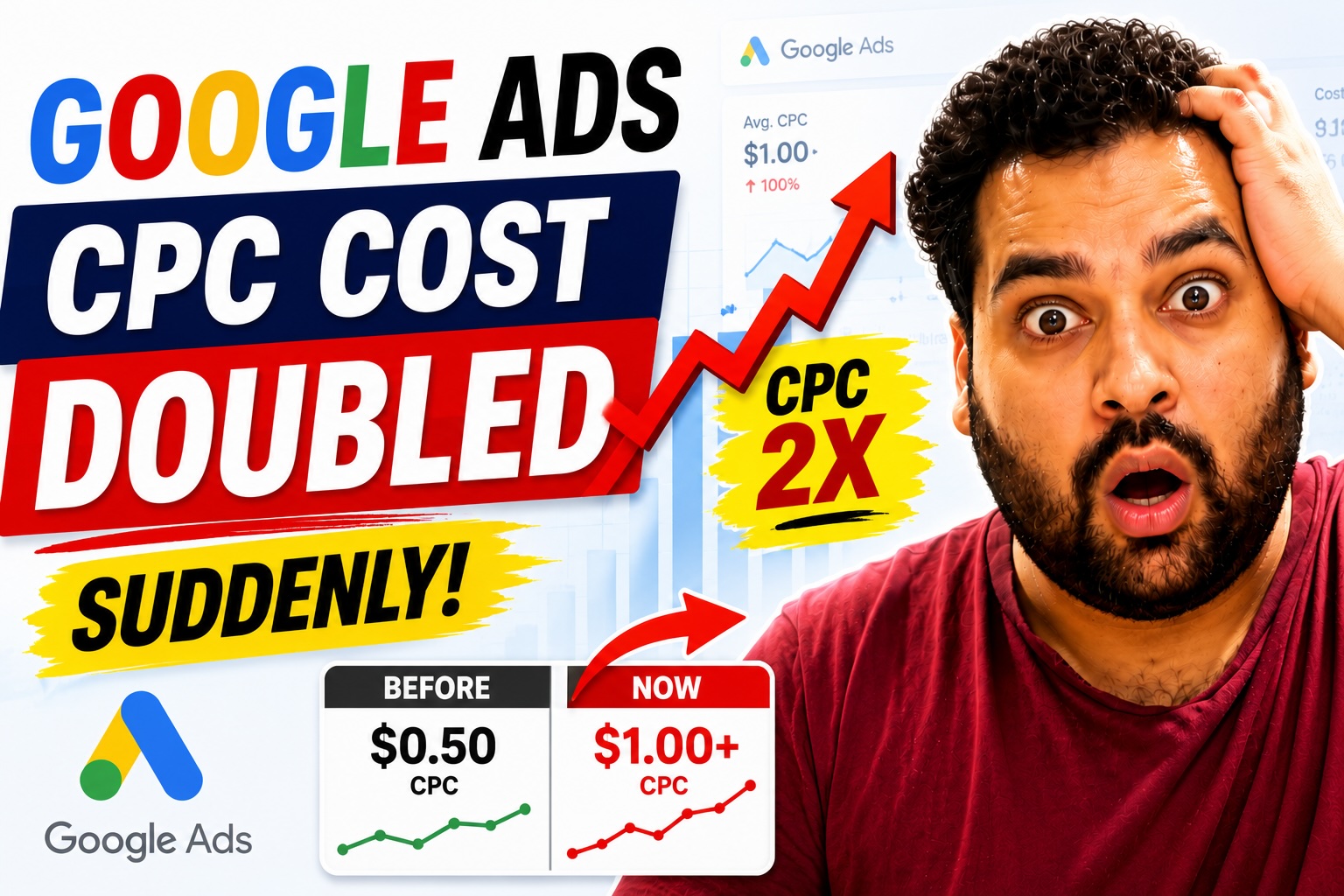
Google Ads CPC Cost Suddenly Doubled [Quick Fix]
Why Has My Google Ads CPC Doubled? 7 Reasons and How to Fix It
Has your Google Ads cost per click suddenly increased during the past few weeks?
You are not alone.
One advertiser recently asked us why the CPC for a fitness brand had almost doubled, particularly for commercial keywords such as “dumbbells.”
A rising CPC can be frustrating, but it does not always mean that Google Ads is malfunctioning.
The increase may be related to:
- Greater competition
- Seasonal demand
- Lower ad relevance
- A decline in click-through rate
- Changes in bidding
- A different search-term mix
- Weaker landing-page experience
- Budget or ranking pressure
- Changes in conversion value
In this guide, I will explain how to diagnose the increase and decide whether it requires immediate action.
What Is CPC in Google Ads?
Cost per click is the average amount you pay when someone clicks your advertisement.
The basic calculation is:
Average CPC = Total click cost ÷ Number of clicks
For example:
If you spend $1,000 and receive 500 clicks, your average CPC is $2.
If the same 500 clicks later cost $2,000, your average CPC has doubled to $4.
However, CPC alone does not tell you whether the campaign is profitable.
You must also examine:
- Conversion rate
- Cost per conversion
- Lead quality
- Cost per customer
- Revenue
- Return on ad spend
- Profit
Why Does Google Ads CPC Increase?
Google Ads operates through auctions.
The cost of a click can change when:
- More advertisers enter the auction
- Existing advertisers bid more aggressively
- Your Ad Rank changes
- Your ads enter different auctions
- Search demand changes
- Your bidding strategy changes
- Your conversion data changes
- Your targeting becomes broader
- Your keyword mix changes
The first step is to determine exactly where the increase occurred.
Before Diagnosing the Problem, Segment the Data
Do not look only at the account-wide average CPC.
Compare CPC by:
- Campaign
- Ad group
- Keyword
- Search term
- Match type
- Device
- Location
- Audience
- Network
- Day
- Hour
- Conversion action
You may discover that the increase is isolated to:
- One keyword
- Mobile traffic
- A particular city
- Broad-match searches
- A new campaign
- Search Partner traffic
- A small group of expensive products
This distinction matters because an account-wide change requires a different solution from a single-keyword issue.
1. Check Keyword-Level Quality Score
Google describes Quality Score as a diagnostic tool that compares the quality and relevance of your advertisement and landing page with other advertisers.
It is shown on a scale from 1 to 10 and is available at the keyword level.
Quality Score is based on three components:
- Expected click-through rate
- Ad relevance
- Landing-page experience
A lower score can indicate that the user experience around a keyword has weakened.
However, Google also states that Quality Score is a diagnostic tool rather than a direct KPI that should become the sole focus of account management.
How to View Quality Score
In Google Ads:
- Open the relevant Search campaign.
- Go to Keywords.
- Select the Columns icon.
- Choose Modify columns.
- Open Quality Score.
- Add:
- Quality Score
- Expected CTR
- Ad Relevance
- Landing Page Experience
- Historical Quality Score components
Compare the current data with earlier periods where historical columns are available.
How to Improve Quality Score
Google recommends:
- Reviewing each Quality Score component
- Making ads more relevant to keywords
- Improving click-through rate
- Updating the landing page
- Using Quality Score alongside other metrics
For a fitness advertiser, avoid placing all product keywords in one generic ad group.
You may create tightly organized themes such as:
- Adjustable dumbbells
- Hex dumbbells
- Dumbbell sets
- Home gym equipment
- Weight benches
- Commercial gym equipment
Each group should have relevant advertisements and landing pages.
2. Review Your Click-Through Rate
Expected CTR is one of the components used in Quality Score.
A declining actual CTR may also reveal that your advertisement is becoming less competitive.
Possible reasons include:
- Competitors are using stronger offers.
- Your prices are less attractive.
- Your headlines are repetitive.
- The advertisement does not match the query.
- The promotion has expired.
- Your ad is appearing in a weaker position.
- The keyword is attracting less relevant traffic.
- The market has become saturated.
Compare:
- Current CTR vs previous period
- Current CTR vs the same period last year
- CTR by device
- CTR by location
- CTR by search term
- CTR by match type
- CTR by advertisement
Do not optimize for CTR alone.
An advertisement can generate many clicks while attracting people who never purchase.
3. Investigate Seasonal Demand
Fitness demand can be highly seasonal.
Searches and advertising activity may increase around:
- New Year fitness resolutions
- Summer promotions
- Holiday sales
- Black Friday
- Major sports events
- New product launches
- Periods of poor weather
- Home-fitness trends
When commercial interest increases, more businesses may compete for the same keywords.
The keyword “dumbbells” can attract:
- Fitness retailers
- Ecommerce marketplaces
- Manufacturers
- Local gym-equipment stores
- Used-equipment sellers
- Large sporting-goods brands
A seasonal increase in competitors can push auction costs upward.
Compare the same period year over year rather than relying only on the previous few weeks.
4. Check Auction Insights for New Competitors
Google’s Auction Insights report compares your visibility with other advertisers participating in the same auctions.
It is available for Search, Shopping and Performance Max campaigns.
For Search campaigns, the report can show metrics such as:
- Impression share
- Overlap rate
- Position above rate
- Top-of-page rate
- Absolute top-of-page rate
- Outranking share
How to Use Auction Insights
Compare:
- This month vs last month
- This quarter vs previous quarter
- Current sale period vs the same period last year
- Brand keywords vs non-brand keywords
- Important product campaigns separately
Look for:
- New domains entering the report
- Competitors gaining impression share
- Competitors appearing above you more frequently
- Increased overlap rates
- Large retailers becoming more aggressive
Auction Insights can reveal changes in competitive visibility, but it does not show the exact bids or budgets of other advertisers.
5. Review Search Impression Share
Search Impression Share is the number of impressions your advertisement received divided by the estimated number of impressions it was eligible to receive.
For example:
If your ads were eligible for an estimated 10,000 impressions and received 2,500, your Search Impression Share would be 25%.
Add these columns where applicable:
- Search Impression Share
- Search Lost IS due to budget
- Search Lost IS due to rank
- Search Top Impression Share
- Search Absolute Top Impression Share
Google defines Search Top Impression Share as impressions received among top ads divided by the estimated top impressions for which the ad was eligible. Absolute Top Impression Share relates to the first ad position among top advertisements.
What a Decline May Mean
A decline may indicate:
- More competition
- Insufficient budget
- Weaker rank
- More restrictive targeting
- Changing auction eligibility
- A different keyword or search-term mix
Search Impression Share is a competitive visibility metric.
It should not be treated as a profitability metric.
6. Improve Advertisement Relevance and Assets
Responsive search ads let you provide several headlines and descriptions. Google then tests combinations and adapts the message to searchers.
For a dumbbell campaign, possible headlines could include:
- Buy Adjustable Dumbbells
- Dumbbell Sets for Home Gyms
- Shop Fitness Equipment Online
- Fast Delivery Available
- Commercial and Home Gym Options
- View Current Dumbbell Prices
Avoid filling every headline with near-identical wording.
Use meaningful variation involving:
- Product type
- Customer benefit
- Price or offer
- Delivery
- Warranty
- Brand trust
- Availability
- Call to action
Add Relevant Assets
Google recommends enabling asset types that make sense for the business.
Useful assets can include:
- Sitelinks
- Callouts
- Structured snippets
- Prices
- Promotions
- Images
- Locations
- Calls
- Seller ratings, where eligible
For a fitness retailer, sitelinks could direct users to:
- Adjustable Dumbbells
- Weight Benches
- Home Gym Packages
- Commercial Equipment
- Sale Products
- Delivery Information
Assets may improve the usefulness and visibility of the advertisement, but they cannot guarantee lower click costs.
7. Review Landing-Page Experience
A user searching for “adjustable dumbbells” should not be sent to a generic homepage requiring several clicks to find the product.
A relevant landing page should contain:
- A headline matching the search intent
- Relevant products
- Clear prices
- Stock information
- Delivery information
- Product specifications
- Customer reviews
- Warranty details
- Mobile-friendly design
- Fast loading
- A prominent purchase action
A poor landing page may reduce conversion rate even when the advertisement attracts the right traffic.
Google includes landing-page experience as a component of Quality Score and recommends updating landing pages where the experience is below average.
Additional Causes of Rising CPC
The original video focuses mainly on Quality Score, competition, CTR, impression share and ad assets.
In practice, you should also check the following areas.
Bidding-Strategy Changes
Did someone recently change:
- Manual CPC to Maximize Clicks?
- Maximize Conversions to Target ROAS?
- The Target CPA?
- The Target ROAS?
- Bid limits?
- Portfolio bidding?
- Conversion goals?
Automated bidding may pay more for clicks it predicts are more likely to convert.
That can increase average CPC while improving conversion value.
Match-Type Changes
Adding broad match or expanding keyword targeting can enter the ads into a different set of auctions.
Review the search-terms report and compare the distribution of:
- Exact match
- Phrase match
- Broad match
- Close variants
Budget Increases
A larger budget may allow the bidding system to enter more competitive auctions.
Check whether the campaign started spending in higher-cost hours, locations or queries.
Device Mix
Mobile, desktop and tablet CPCs can differ.
An account-wide increase may simply reflect a larger share of traffic coming from a more expensive device category.
Location Mix
A campaign that begins receiving more clicks from expensive cities may experience a higher average CPC without any change to its main keywords.
Product or Margin Changes
For ecommerce advertisers, rising CPC may be acceptable when the promoted products have:
- Higher prices
- Better margins
- Larger baskets
- Higher repeat-purchase value
Always connect advertising costs with commercial value.
Should You Lower Your Bids Immediately?
Not necessarily.
Lowering bids may reduce CPC, but it can also reduce:
- Visibility
- Traffic
- Top-of-page presence
- Sales
- Conversion volume
Before reducing bids, determine whether the increased CPC is harming profitability.
Compare:
Before
- CPC
- Conversion rate
- Cost per sale
- Average order value
- Revenue
- Profit
After
- CPC
- Conversion rate
- Cost per sale
- Average order value
- Revenue
- Profit
A higher CPC can be acceptable when conversion quality improves.
Why CPC Alone Can Be Misleading
Consider two periods.
Period One
- 1,000 clicks
- Average CPC: $1
- Spend: $1,000
- 10 sales
- Cost per sale: $100
Period Two
- 500 clicks
- Average CPC: $2
- Spend: $1,000
- 25 sales
- Cost per sale: $40
The CPC doubled, but the campaign became considerably more efficient.
For ecommerce, track:
- Cost per sale
- Conversion value
- ROAS
- Profit margin
- Average order value
- New customer cost
- Lifetime value
For lead generation, track:
- Cost per enquiry
- Qualified-lead rate
- Appointment rate
- Closing rate
- Cost per customer
- Contract value
Google Ads CPC Troubleshooting Checklist
When CPC suddenly rises, check:
- Which campaigns caused the increase?
- Which keywords became more expensive?
- Did search terms change?
- Did match types change?
- Did bidding change?
- Did the budget change?
- Did Quality Score components decline?
- Did CTR fall?
- Did landing-page performance worsen?
- Did new competitors appear?
- Did impression share change?
- Did location or device mix change?
- Did conversion rate improve or decline?
- Did cost per sale increase?
- Did revenue or profit decline?
Do not make several major changes simultaneously.
When you change the bids, keywords, ads, landing page and targeting at once, it becomes difficult to identify which action improved or damaged performance.
Frequently Asked Questions
Why did my Google Ads CPC suddenly double?
Possible reasons include greater competition, seasonal demand, bidding changes, broader search terms, weaker relevance, a lower CTR, location changes or a different traffic mix.
Does a lower Quality Score increase CPC?
Quality Score can help diagnose weaker expected CTR, ad relevance or landing-page experience. Google states that it should be used diagnostically rather than as the account’s main KPI.
How can I check new Google Ads competitors?
Use Auction Insights and compare the current date range with a previous period.
What does Search Impression Share mean?
It is the percentage of impressions received compared with the estimated impressions for which the ads were eligible.
Will adding ad assets reduce CPC?
Relevant assets may make advertisements more useful and prominent, but they do not guarantee lower CPC. Google recommends enabling the asset types that support the business goal.
Should I pause keywords with high CPC?
Not solely because they are expensive.
Review conversion rate, sales, profit and customer value before deciding.
Can a keyword with a high CPC still be profitable?
Yes. A high-cost keyword can be profitable when it generates enough qualified customers, revenue or lifetime value.
How often should Auction Insights be reviewed?
Review it regularly and whenever you notice a significant change in CPC, impression share or conversion performance.
Can AARSWEB Solutions audit my Google Ads account?
Yes. Our team provides Google Ads audits, setup, conversion tracking, optimization and ongoing management.
Final Thoughts
When Google Ads CPC doubles, do not immediately assume the platform is broken.
Start with a structured diagnosis.
Review:
- Quality Score components
- Search terms
- CTR
- Landing-page relevance
- Auction Insights
- Impression Share
- Bidding changes
- Devices
- Locations
- Conversion economics
Most importantly, do not manage Google Ads around CPC alone.
A click is not the final business objective.
The objective is to acquire qualified customers at a cost that produces acceptable profit.
Need Help Reducing Wasted Google Ads Spend?
AARSWEB Solutions provides:
- Google Ads audits
- Search campaign management
- Ecommerce advertising
- Fitness and retail campaign management
- Keyword analysis
- Conversion tracking
- Landing-page recommendations
- Performance Max management
- Google Merchant Center support
- Suspension and disapproval assistance
Visit AARSWEBS.com to discuss your campaign with our team.
Disclaimer
This article provides general educational information.
Every account is different, and no single CPC-reduction strategy is suitable for every campaign.
AARSWEB Solutions is an independent digital marketing company and is not affiliated with or endorsed by Google.