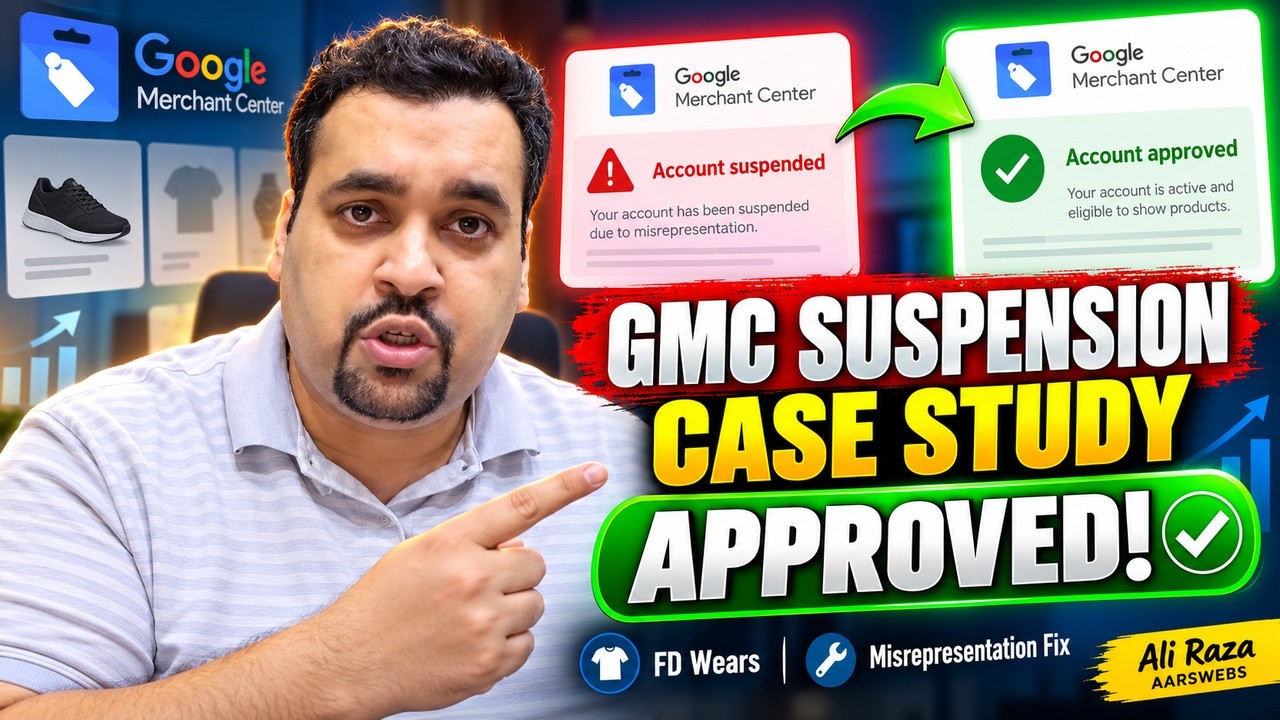
Google Merchant Center Misrepresentation Reinstated: FD Wears Case Study (2026)
Google Merchant Center Misrepresentation suspension can become especially difficult when identity verification fails. FD Wears, an online clothing and leather jacket business, encountered both issues. Its Merchant Center account was suspended, and during the restoration process it also reached the maximum number of identity verification attempts.
In this real-world 2026 case study, the AARSWEBS team explains its multi-stage compliance review, website fixes, and communication with Google Support. After extensive work, Google confirmed that the client’s Merchant Center account had been reapproved and was in good standing. The team subsequently checked that products were approved.
Watch the full video walkthrough: Google Merchant Center Suspension Restored — FD Wears Case Study.
At a glance: the FD Wears recovery
- Business: FD Wears, an online clothing and leather jacket store.
- Primary concern: Merchant Center suspension for Misrepresentation.
- Additional obstacle: Identity verification failures, including exhausted verification attempts.
- Review scope: Website code, business information, store policies, broken links, brand signals, Merchant Center, Google Search Console, and Google Business Profile.
- Outcome: Google Support confirmed reapproval and good standing; products were shown as approved.
Why the account needed more than a routine appeal
It was not a simple matter of editing one line of text and requesting another review. The suspension and verification problems developed over time. Some review stages did not require identity verification; later, verification became an additional hurdle. Repeated requests did not resolve the problem, and the account eventually exhausted the permitted verification attempts.
At AARSWEBS, we approached the case with our 200+ Point Compliance Framework. The framework helps us systematically check for issues across the business’s website and connected Google properties. It does not imply that every checkpoint was a defect in this case or that Google disclosed the exact cause of the suspension.
What our compliance audits uncovered
1. Hidden demo-domain references and coding issues
One audit found traces of an old demo domain and unfinished elements in the website’s code. These items were not necessarily obvious on the public-facing storefront, but they deserved correction before another compliance review. We also examined loading issues and page quality.
2. Conflicting business contact details
Different pages displayed inconsistent contact numbers and details. For an online shop, buyers should be able to identify and contact the business without contradictory information. We worked to align the published details and reviewed consistency with other online profiles.
3. Shipping-location and return-policy ambiguity
The store’s shipping text referred to fulfillment locations in the UAE and South Asia, while other pages presented business address information differently. We reviewed how the store explained its operations, shipping, returns, and customer responsibilities.
4. Broken links, placeholders, and unfinished pages
Audits also identified outdated internal links, work-in-progress placeholders, and pages needing clearer content. The team reviewed navigation, product pages, and trust-building information. Content was updated with the client’s approval.
5. Brand consistency beyond the storefront
Our work covered social links, public business information, Google Search Console checks, and Google Business Profile details. Consistent, accurate information helps make the merchant’s identity understandable to users, even though no individual item guarantees account approval.
What happened when identity verification attempts were exhausted?
A particularly difficult point came when the account displayed that identity could not be verified and that the maximum number of attempts had been reached. That limited the standard in-product verification path. The AARSWEBS team continued to document corrections and communicate with Google Support about the outstanding problems.
Support initially directed the team to review account and website policy issues thoroughly. We continued resolving the identified concerns and sharing relevant information for review. The case involved more than one round of audits and support correspondence.
The outcome: Merchant Center reapproved
In the video, we show the subsequent correspondence from Google Support stating that the Merchant Center account had been reapproved and was in good standing. A follow-up support message reported no active suspension or warning. The team also checked the account and demonstrated approved products.
This is a documented successful client outcome, not a guarantee that the same steps will resolve another merchant’s suspension. Google’s final review and enforcement decisions are its own, and the specific signals involved can differ from account to account.
Five useful lessons for merchants dealing with Misrepresentation
- Audit your full store, not just the warning banner. Check policies, contact details, technical issues, checkout clarity, product content, and public business information.
- Look for inconsistencies. Compare contact numbers, business identity, shipping information, and social media references across pages.
- Do not ignore hidden website content. Old demo references and abandoned template text deserve review even if the homepage appears polished.
- Document each correction. Keep a clear record of the errors found, edits made, and communications received.
- Distinguish automated verification from manual support review. Available options vary by case. An exhausted attempt limit does not mean that repeated submissions are a good strategy.
Frequently asked questions
Can a suspended Merchant Center account be reinstated after identity verification fails?
It can happen. In this case, the account was ultimately reapproved after extensive website work and communication with Google Support. Reinstatement depends on Google’s case-specific review.
Are mismatched phone numbers or broken links always the reason for Misrepresentation?
No. They were issues our team considered important to address during this audit. Google did not identify one specific correction as the sole reason for the successful outcome.
Does AARSWEBS guarantee Merchant Center approval?
No. We provide audits, compliance remediation guidance, and support throughout the agreed service scope. Google controls the final decision. AARSWEBS does not guarantee reinstatement and follows its published no-refund policy.
For a more technical breakdown: Read Ali Raza’s lessons from the FD Wears identity verification and Misrepresentation case.
Need help reviewing a suspended Merchant Center account?
If your business is dealing with Misrepresentation, identity verification problems, or a broader Merchant Center suspension, explore our Google Merchant Center suspension review and reinstatement services. Our team can help investigate website issues, improve policy compliance, and prepare a clearer route through the available review process.
Case-study note: Details are based on the AARSWEBS team’s experience and the correspondence shown in the linked video. Individual results vary; no approval is guaranteed.