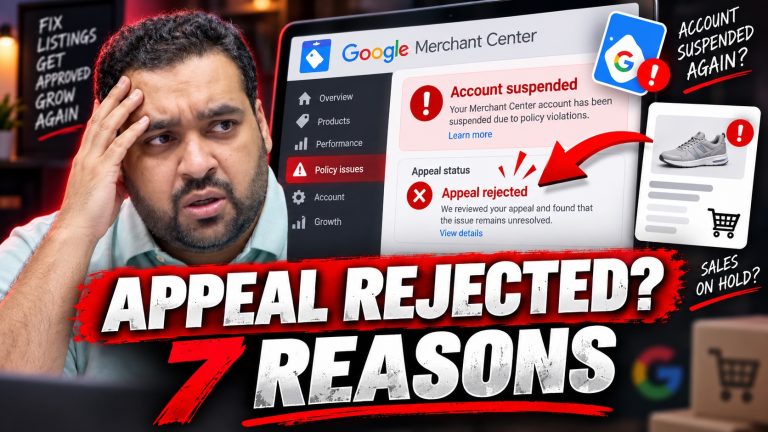
Google Merchant Center Misrepresentation Suspension Restoration Case Study: How We Restored a Suspended Account
Getting a Google Merchant Center account suspended for misrepresentation can be frustrating.
What makes it even more challenging is that the problem isn’t always one obvious mistake.
Your website may look professional. Your products may be genuine. Your checkout may appear to work correctly. You may even have your privacy, shipping and refund policies published.
And still, Google Merchant Center may suspend the account.
We recently worked on a Google Merchant Center project where the account went into suspension for misrepresentation during the account setup process.
What initially looked like a straightforward restoration turned into a detailed compliance project involving multiple website audits, policy corrections, checkout testing, product-page improvements, business information verification, Search Console fixes and Merchant Center configuration changes.
Eventually, after the issues were addressed and a review was requested, the misrepresentation issue was removed and the Merchant Center account was restored.
In this case study, I’m going to discuss some of the important issues our team identified and what we changed during the restoration process.
Important: Every Google Merchant Center suspension is different. The changes discussed in this case study describe this particular project and should not be treated as a guarantee that making the same changes will restore another account.
Google Merchant Center Misrepresentation Suspension: The Situation
Our responsibility on this project included helping establish the client’s Google Merchant Center presence.
During the process, however, the Merchant Center account was suspended for misrepresentation.
Instead of immediately making a few random changes and repeatedly requesting reviews, our team started looking at the entire eCommerce ecosystem.
This included:
- The website
- Google Merchant Center
- Checkout experience
- Business information
- Product pages
- Shipping information
- Refund information
- Payment methods
- Legal and policy pages
- Testimonials and business claims
- Google Search Console
- Structured product data
- Social profiles
- Advertiser verification
This broader approach became important because we didn’t find just one issue.
We found numerous inconsistencies and potential compliance risks across the website and associated business information.
What Does Misrepresentation Mean in Google Merchant Center?
For an eCommerce store, trust and consistency matter.
The information customers see about your business, products, pricing, shipping, payments and returns should provide a consistent representation of the company and shopping experience.
In this particular audit, we found issues ranging from contradictory business information to inconsistent payment claims, unclear policies and product-page problems.
Individually, some of these problems could look small.
Together, they created a much larger compliance problem.
And this is an important lesson from this Google Merchant Center restoration case study:
Don’t look only for one big error. Look for inconsistencies across the entire customer journey.
Our Initial Google Merchant Center Misrepresentation Audit
One of our early audits identified several areas that required attention.
1. Contradictory Business Identity and Location Information
Business information needs careful attention.
During the audit, we discovered confusing combinations of business/location information, telephone details and time-zone information.
For example, information connected with Chandigarh, India appeared alongside Eastern Standard Time references.
Even something as simple as writing business hours or time zones differently across different locations can introduce unnecessary inconsistencies.
We therefore reviewed business details across the relevant website pages and associated properties.
2. Testimonials and Brand Claims
Testimonials were another area that required work.
Some testimonial information referenced a different brand, while other claims needed stronger verification or context.
We also reviewed whether testimonials could be connected to an identifiable source, product page or appropriate third-party review source.
Testimonials shouldn’t simply exist to make a website look trustworthy.
They should represent genuine, supportable customer feedback.
3. Shipping and Pricing Inconsistencies
We checked shipping information across the website and Merchant Center.
A customer shouldn’t see one shipping promise on a product or policy page and encounter something substantially different elsewhere in the shopping process.
We therefore cross-checked relevant shipping, processing and pricing information rather than treating each page independently.
4. Contact Information
Contact information was another surprisingly important part of the audit.
At one point, an obviously invalid-looking telephone number was present on the website.
Small details like this can damage the credibility of an online store.
We reviewed the contact information and checked it alongside the other business information being presented.
Payment Method Mismatch: A High-Risk Issue We Found
One particularly clear inconsistency involved PayPal.
Part of the website indicated that PayPal was accepted, but PayPal wasn’t actually available during checkout.
Think about that from the customer’s perspective.
If your payment policy tells a customer that a payment method is available but they cannot use it at checkout, your website is presenting contradictory information.
Our team therefore checked the payment methods displayed in areas such as the footer and policy pages against the payment options customers could actually use during checkout.
The lesson is simple:
Don’t advertise payment methods that your checkout doesn’t actually support.
We Tested the Complete Checkout Process
We didn’t stop after reading the policy pages.
We tested the actual buying experience.
Products were added to the cart and the team moved through the checkout process while looking for inconsistencies, broken functionality and compliance issues.
We checked areas including:
Add to cart → View cart → Shipping → Payment options → Checkout
We also examined the experience across different devices.
Why?
Because a store may appear fine on one device while a customer encounters an error somewhere else.
For a Merchant Center restoration project, the practical shopping experience deserves just as much attention as the text written in your policies.
Policy Pages We Reviewed and Improved
A significant amount of work went into the website’s trust and policy content.
The website contained or received work around pages and disclosures including:
- Shipping Policy
- Privacy Policy
- Return & Refund Policy
- Terms of Service
- Payment Policy
- Disclaimer
- Do Not Sell Information
- Cookies Policy
- Copyright Notice
- Accessibility Statement
- Security Statement
- About Us
- Contact Us
But simply creating these pages isn’t enough.
We also cross-checked the information.
If your refund policy says one thing while Merchant Center says something else, you haven’t necessarily solved the problem by merely having a refund-policy URL.
Consistency is the real objective.
About Us and FAQ Improvements
We also redesigned important trust-related content, including the About Us and FAQ areas.
These pages help users understand who is behind the store, what the company does and what customers should expect.
For an online business, your website shouldn’t feel anonymous.
The information should make sense alongside your contact information, products, policies and overall brand identity.
Product Page Improvements
Product pages received substantial attention during the restoration process.
Among the issues examined were missing or insufficient:
- Product descriptions
- SKU information
- GTIN information where applicable
- Shipping information
- Return information
- Order limits
- High-quality product images
We also looked at the practical quantity customers could add to their carts.
If a store effectively allows an unrealistic quantity of a product to be ordered without sensible limits, that can create another questionable user experience.
The objective was to make the product pages more complete and useful for both shoppers and the systems processing the product information.
Improving Product Image Quality
Product images matter as well.
Customers can’t physically hold an eCommerce product before buying it, so your images form an important part of the product experience.
We reviewed product image quality and worked on improving the overall presentation of the products.
This was part of a larger effort to improve the quality and credibility of the store rather than merely chasing a suspension message.
Adding Better Website Content
Another addition during the project was the website’s blog/content section.
The purpose wasn’t simply to publish random articles.
The broader objective was to develop the website into a more complete business resource rather than leaving it as a collection of thin commercial pages.
Content should support the business and its customers.
Technical and Structured Data Issues
Not every issue was visible on the front end.
Our audits also examined technical risks involving structured product information.
Areas requiring attention included information relating to:
- Price
- Availability
- Checkout consistency
- Structured data
- Tax/VAT disclosures
- Merchant listings
- Product-source information
This is why a Merchant Center audit shouldn’t be limited to how attractive a Shopify or eCommerce store looks.
A website can look excellent visually and still have technical issues underneath it.
Placeholder Content Can Become a Problem
Another interesting issue involved placeholder content.
Placeholder information can remain inside forms, plugins, newsletters or other areas of a website after development.
In this project, for example, a newsletter/subscribe area became one of the items addressed during the cleanup.
We reviewed forms and website components for placeholder-related issues instead of assuming that only major pages mattered.
It demonstrates why a detailed audit can sometimes uncover problems that a store owner may overlook during a normal visual inspection.
Footer Consistency
The footer was also reviewed.
Why bother with a footer during a Merchant Center restoration?
Because that’s often where businesses display important information such as:
- Contact details
- Payment methods
- Policy links
- Company information
If the footer says one thing and another part of the website says something different, you’ve introduced another inconsistency.
We therefore checked these smaller website elements as part of the broader compliance process.
Website Speed and User Experience
Website performance was another consideration raised during the audits.
At one point in the process, the site’s measured performance needed improvement, and optimization was recommended.
Speed wasn’t treated as an isolated magic solution to the Merchant Center suspension.
Instead, it was part of improving the overall website and customer experience.
That’s an important distinction.
Restoration work shouldn’t become a hunt for one mythical setting that automatically gets an account approved.
Matching Information Across the Website, Merchant Center and Social Profiles
One recurring theme throughout this project was consistency.
We examined whether relevant business information aligned across the website, Merchant Center and associated profiles.
Consider basic information such as:
Business name → Address → Telephone → Business hours → Time zone → Shipping → Returns → Payments
If one source says one thing and another says something substantially different, the business can appear less trustworthy.
This is why we spent significant time cross-checking information rather than simply rewriting a few website pages.
Google Search Console Problems
The project also involved technical issues in Google Search Console.
Our team encountered crawler-related problems and Merchant listing structured-data issues.
The sitemap also produced a Couldn’t fetch problem at one stage.
That issue was investigated and corrected, after which the sitemap showed a successful status.
Again, this illustrates the scope of the project.
This wasn’t:
Suspended → Change one policy → Submit appeal → Done.
It required repeated audits and technical troubleshooting.
Advertiser Identity Verification
Advertiser verification was another part of the process.
The client provided the necessary documentation, and our team assisted with submitting the information.
During communication regarding the account, the next recommended step after key policies and contact details had been corrected was to complete identity verification and then request a review.
Once the required work was completed, we proceeded toward the review stage.
Updating Merchant Center Product Source Information
We also worked on the Merchant Center product-source information.
Relevant configuration included items such as:
- Feed labels
- Marketing methods
- Language
- Product information
- Product source
The objective, again, was to ensure the Merchant Center setup accurately reflected the store and its products.
We Didn’t Rely on a Single Audit
One of the biggest lessons from this project is that a serious Merchant Center restoration can require multiple audits.
We repeatedly found smaller issues after larger issues had already been corrected.
One audit might uncover business information.
Another might reveal a payment inconsistency.
Another might identify a product-page problem.
Another might expose technical or structured-data errors.
This is why immediately requesting another review after making one or two cosmetic changes may not address the underlying problems.
Our process was much closer to:
Audit → Fix → Cross-check → Test → Audit again → Resolve technical issues → Verify information → Request review
Requesting the Google Merchant Center Review
After the major issues had been addressed, identity verification and the relevant technical work were completed, the account reached the stage where another review could be requested.
We submitted the review.
And eventually, we received the email we had been working towards.
The requested misrepresentation review was completed, the issue no longer appeared in the Merchant Center account, and the account was restored.
The Result: Google Merchant Center Account Restored
After restoration, we checked the live account again.
Products that previously weren’t approved moved into approval, and products were running and receiving clicks.
We also reviewed the account notifications and didn’t see the previous suspension warning requiring attention.
So the final outcome of this project was:
Suspended for Misrepresentation → Detailed Compliance Work → Review → Misrepresentation Issue Removed → Merchant Center Restored → Products Approved
It was a successful Google Merchant Center restoration project and, more importantly, a team effort involving repeated auditing and corrections rather than a shortcut.
What We Learned From This Google Merchant Center Restoration
If there’s one thing I would highlight from this case study, it’s this:
Small inconsistencies can become a big problem.
A wrong telephone number may look minor.
A time-zone mismatch may look minor.
A PayPal logo when PayPal isn’t available may look minor.
A different shipping statement on another page may look minor.
A testimonial without a clear source may look minor.
A placeholder hidden in a form may look minor.
But when a website contains numerous contradictory or incomplete signals, fixing only one of them doesn’t make the entire business presentation consistent.
That’s why our approach to Merchant Center restoration involves examining the broader ecosystem.
Google Merchant Center Suspension Restoration Checklist
If your own Merchant Center account has been suspended for misrepresentation, areas worth auditing include:
- Business name, address and contact information.
- About Us and Contact Us information.
- Shipping and processing information.
- Return and refund information.
- Privacy and legal policies.
- Payment methods versus actual checkout options.
- Product descriptions and identifiers.
- Product images.
- Pricing and availability information.
- Checkout functionality.
- Structured product data.
- Placeholder/demo content.
- Testimonials and business claims.
- Footer information.
- Business hours and time-zone consistency.
- Merchant Center business information.
- Product-source/feed information.
- Search Console and sitemap issues.
- Relevant social/business-profile information.
- Verification requirements.
Don’t blindly change all of these just because they appeared in this case study.
Instead, audit your particular website and account to determine what is actually inaccurate, incomplete or inconsistent.
Need Help With a Suspended Google Merchant Center Account?
AARSWEBS provides digital marketing and eCommerce advertising support, including work involving Google Merchant Center, Google Shopping and Google Ads management.
If your Merchant Center account has been suspended for misrepresentation or you’re struggling to identify the issues preventing your store from moving forward, our team can review the account, website and related setup.
We don’t believe in promising an automatic approval because the final decision belongs to Google.
What we can do is systematically identify problems, work through the relevant areas and help you build a more consistent and compliant setup before requesting a review.
Contact AARSWEBS to discuss your Google Merchant Center suspension and restoration requirements.
Frequently Asked Questions
Can a Google Merchant Center account suspended for misrepresentation be restored?
Yes, restoration can happen. In the case documented here, the account’s misrepresentation issue was eventually removed after extensive website, Merchant Center and technical work followed by a review.
However, this case shouldn’t be interpreted as a guarantee that every suspended account will be restored.
What should I check after a Google Merchant Center misrepresentation suspension?
Start by auditing the entire shopping experience rather than changing one random item. In this project, relevant issues included business information, contact details, policies, checkout, payments, shipping, testimonials, product information, structured data and technical website issues.
Can inconsistent payment methods cause problems?
Payment information should accurately represent what customers can actually use. In this case, PayPal was mentioned in website information even though it wasn’t available at checkout, so the inconsistency was corrected.
Are policy pages enough to fix Merchant Center misrepresentation?
Simply publishing policy pages wasn’t enough in this project. The information also had to be reviewed and cross-checked for consistency with the website, checkout and Merchant Center setup.
Should I request a review immediately after making changes?
This case demonstrates why completing a detailed audit first can be valuable. Our team went through multiple rounds of auditing and corrections before reaching the final review stage.
Does AARSWEBS guarantee Merchant Center reinstatement?
No legitimate restoration process should be presented as guaranteed. Google controls its review and approval decisions. Our role is to help identify and correct issues and prepare the account and website for review.
Can AARSWEBS also manage Google Shopping and Google Ads?
Yes. Alongside Merchant Center restoration work, AARSWEBS provides Google Ads, Google Shopping and Merchant Center management services.
Conclusion
Restoring a Google Merchant Center account suspended for misrepresentation isn’t always about discovering one giant mistake.
In this case, success came from finding and correcting numerous details across the website, checkout, policies, product pages, business information, Merchant Center configuration and technical setup.
Some issues were obvious.
Others were hidden in places most store owners wouldn’t immediately check.
After multiple audits, corrections, verification work and technical fixes, we requested another review. The misrepresentation issue was subsequently removed, the Merchant Center account was restored and products showed as approved again.
If you’re facing a similar suspension, don’t treat restoration as a guessing game.
Audit carefully. Fix the inconsistencies. Test the customer journey. Cross-check your information. Then approach the review process with a cleaner and more credible setup.
And if you need professional assistance, AARSWEBS can help with Google Merchant Center restoration, Google Shopping and Google Ads management.