
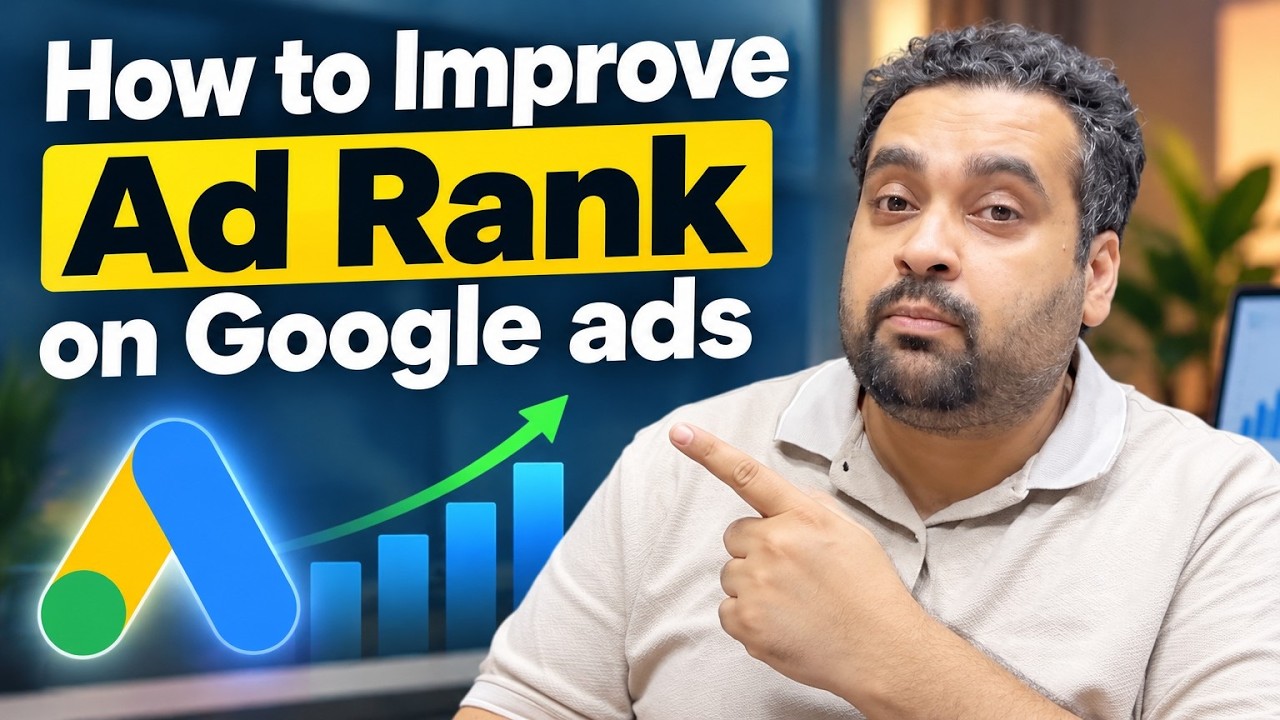
Google Ads Search Lost IS (Rank) High? 3 Ad Rank Fixes That Matter
High Google Ads Search Lost IS (rank)? If your search ads are missing eligible impressions while competitors appear more often, you may have an Ad Rank issue. But raising bids isn’t the only lever. In our founder Ali Raza’s latest Q&A video, he outlines three practical areas to review: keyword–ad–landing-page relevance, useful ad assets, and campaign structure aligned with intent and geography.
The most effective plan depends on your auction, budget, quality and conversion economics. This guide shows how to diagnose the problem properly, improve the experience users actually see and test changes without creating unnecessary campaigns or landing pages.
Watch: How to Improve Ad Rank in Google Ads
Watch the full Google Ads Ad Rank video.
Video chapters: 00:00 Viewer question about Ad Rank · 00:52 Relevance and keyword-to-page alignment · 01:24 Dedicated ads and landing pages · 01:51 Ad assets and preview examples · 02:42 Account structure · 03:01 New Jersey location example · 03:50 Final advice.
What Is Google Ads Search Lost IS (rank)?
Google defines Search Lost IS (rank) as the estimated percentage of eligible impressions your Search ads missed because their Ad Rank was insufficient in the auction. This is different from Search Lost IS (budget), which measures opportunities missed because the campaign’s budget was inadequate.
For example, if a campaign shows 35% Search Lost IS (rank), that represents roughly 35% of eligible search impression opportunities missed on account of rank during the selected reporting period—not a guarantee that fixing the issues will recover exactly that many clicks, conversions or sales. Impression-share metrics are estimates, and the eligible opportunity changes with auction conditions.
What Determines Google Ads Ad Rank?
According to Google’s Ad Rank documentation, Ad Rank uses several inputs: the bid, expected quality of the ad and landing page, minimum Ad Rank thresholds, competitiveness, search context, and expected impact of assets and formats. Google recalculates it for each auction and different ad positions.
Quality Score is not Ad Rank. The displayed 1–10 Quality Score is a diagnostic based on expected click-through rate, ad relevance and landing-page experience. Google explicitly says this score itself isn’t used as an input in the ad auction; actual auction-time quality signals matter. Use the diagnostic components to identify what deserves improvement.
1. Improve the Three-Way Relevance Between Keyword, Ad and Landing Page
This is Ali’s strongest recommendation. When the user’s search intent matches the keyword theme, advertisement and landing page, the whole journey is clearer and often converts better. A generic ad leading to a generic homepage can cause friction, especially if a prospective customer is looking for a specific service, location or promotion.
Suppose someone searches emergency AC repair in Dubai Marina. A highly relevant experience might include an ad describing the emergency service in that area, followed by a page that clearly explains availability, coverage, contact options and the promised service—not an unrelated list of every service your business offers.
In the video, Ali suggests an individual ad and landing page for each of ten winning keywords as an aggressive way to maximize message matching. This can be reasonable when the keywords represent genuinely different intents, but it is not a Google requirement. In most accounts, clusters of closely related keywords can share a strong, intent-focused ad group and landing page. Duplicating ten nearly identical pages may create maintenance problems without improving ad quality.
Practical relevance checklist
- Group keywords based on what the searcher is really asking for, not just spelling differences.
- Use the same service or product promise in the headline, description and landing-page opening.
- Present essential information, trust details and a straightforward conversion action.
- Test mobile loading, form behavior and page navigation. A page that frustrates visitors can undermine performance.
- Review expected CTR, ad relevance and landing-page experience in keyword Quality Score diagnostics.
Google’s ad and landing-page optimization guide explicitly recommends ensuring the clicked page fulfills the expectations established by the ad.
2. Add Useful Ad Assets to Improve the Ad Experience
In the video, Ali points to assets such as call, location, pricing and promotional details. Today these are called ad assets, not ad extensions. Relevant sitelinks, callouts, structured snippets, image assets, location assets, call assets and price or promotion assets can make an ad more informative.
Google includes the expected impact of assets and formats in Ad Rank. Assets are selected for eligibility and shown based on auction and placement conditions, so adding one doesn’t guarantee it appears in every impression or automatically increases CTR. Use genuine information that matches the business; avoid irrelevant or misleading extras.
| Asset | When it helps |
|---|---|
| Sitelinks | Direct people to specific services, contact, pricing or reviews |
| Call asset | Make phone contact easier for eligible lead-generation businesses |
| Location asset | Show legitimate location information for suitable local advertisers |
| Price / promotion assets | Show accurate price points and real current offers |
| Callouts / structured snippets | Highlight legitimate service details and categories |
Review Google’s asset guidance for eligibility and the factors that affect whether assets appear. Focus on incremental qualified leads, not just the number of assets displayed.
3. Improve Campaign Structure Where It Improves User Intent and Geography
Ali’s third recommendation concerns creating an effective campaign structure. In the video, he explains a situation where New Jersey underperforms in a campaign serving several areas. His options: exclude that region if it is genuinely poor-quality, or move it into a dedicated campaign with its own message, landing page and budget when there is good commercial potential to test separately.
The distinction: Simply moving identical keywords and ads into more campaigns does not directly improve Google Ads quality. Google says account structure by itself isn’t an ad-quality factor. It matters only insofar as the restructuring lets you create more relevant experiences, control budgets, test local offers or correct weak traffic.
If performance differs meaningfully by city, examine location reports, lead quality, cost per acquisition, available budgets and actual servicing capacity. A dedicated local campaign may work when you need customized ad copy, different hours or budgets and a real local landing page. If there is little data or no meaningful difference, unnecessary splits may fragment learning and reporting.
A Seven-Point Audit for High Search Lost Impression Share (Rank)
- Validate the problem: Compare Search Lost IS (rank) with Search Lost IS (budget) for the same date range and campaign.
- Check real visibility: Review top impression share, absolute-top impression share, search impression share and Auction Insights if available.
- Inspect diagnostic quality: Add expected CTR, ad relevance, landing-page experience and Quality Score columns.
- Improve intent alignment: Fix misaligned keyword groups, generic messaging and landing pages that don’t fulfill ad promises.
- Upgrade useful assets: Add accurate sitelinks, calls, prices, promotions or other assets relevant to your business.
- Review bids and economics: Ad Rank also involves bids and auction thresholds; check your actual bidding strategy, target CPA/ROAS or CPC controls without blindly increasing bids.
- Run a controlled test: Record qualified leads, conversions, cost per acquisition and rank-lost impression share before and after the change.
Don’t confuse a higher ad position with guaranteed profitability. If extra visibility produces lower-quality traffic or much higher acquisition costs, the change may not help the business.
Frequently Asked Questions About Google Ads Ad Rank
What is the fastest way to improve Ad Rank?
There is no universal fastest fix. Diagnose low rank-loss impressions with quality, bids, context and assets, then prioritize the most material issue. Improving a broken landing-page experience can be more useful than creating extra campaigns; in other auctions, bid constraints may matter most.
Does improving Quality Score directly improve Ad Rank?
The displayed 1–10 Quality Score is diagnostic, not an auction input. But improving the underlying user experience and actual ad quality can benefit auction-time rank.
Do I need one landing page for every keyword?
No. Use distinct landing pages where search intent genuinely differs. Closely related keywords may be served effectively by the same relevant page.
Does adding sitelinks guarantee higher Ad Rank?
No. Google considers expected asset impact, but assets also require eligibility and aren’t guaranteed to display.
Should I split a campaign by city?
Only when separate local budgets, ad messages, landing pages, operational needs or meaningful performance differences justify the extra complexity.
Get a Practical Google Ads Ad Rank Audit
Losing Impressions While Competitors Get the Clicks?
AARSWEBS reviews Search Lost IS (rank), Quality Score diagnostics, keyword intent, landing-page CRO, ad assets, bid strategies and location performance. We also include competitor analysis and click-fraud monitoring in all Google Ads management plans.
Request Your Free Google Ads Audit →
View Google Ads Management Services
No guaranteed top position, impression share or return. Individual results depend on the auction and account.
Related reading: Which Google Ads change makes the biggest difference? and How many ad headlines and assets should you use?.
Sources: About Ad Rank, Impression share, Quality Score, What matters for ad quality. The three-part framework is from Ali’s video; technical qualifications and definitions come from Google’s current help articles.





One Comment