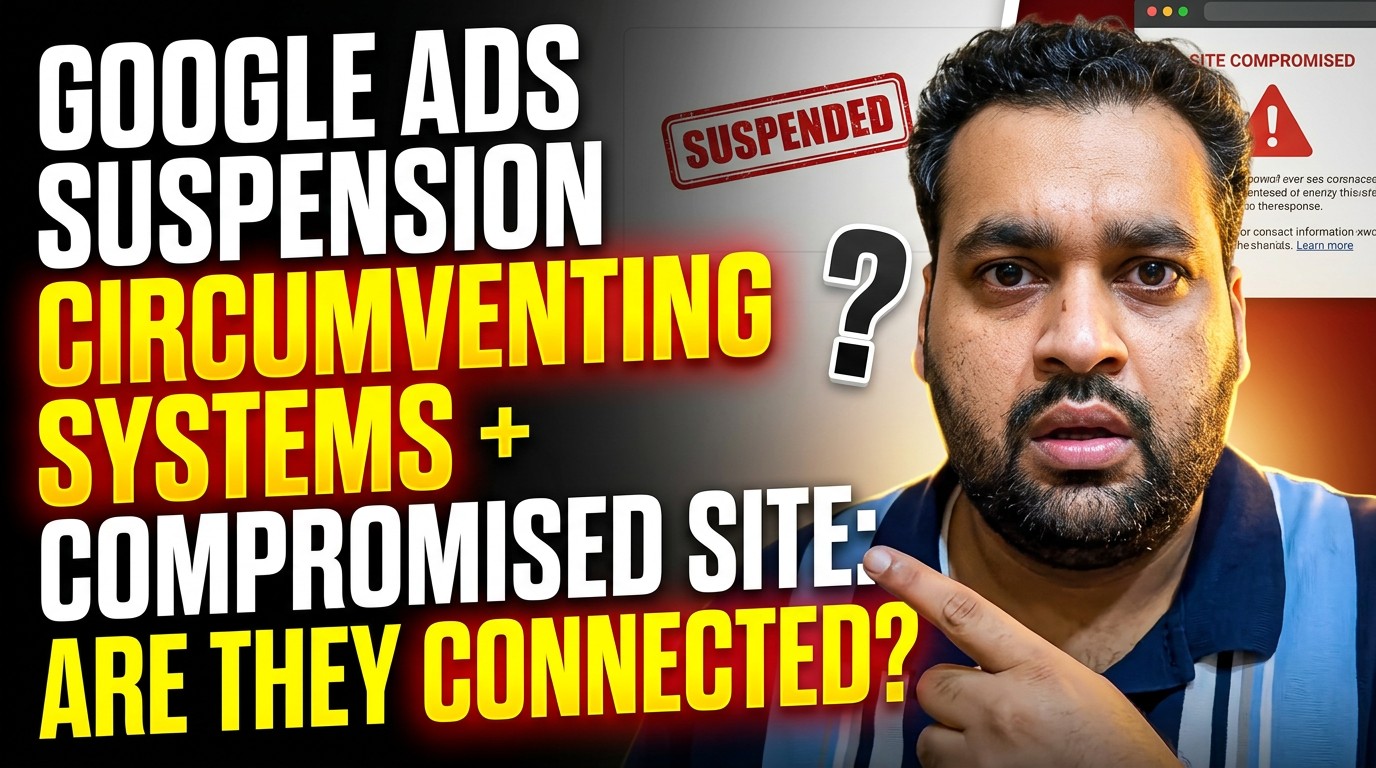
Can a Hacked Website Cause a Google Ads Cloaking Suspension? Compromised Site + Circumventing Systems Explained
A recent Google Ads suspension question raised an important technical issue.
The advertiser said their Google Ads account had been hacked.
Around the same time, Google identified two separate policy problems:
- The advertising destination was flagged as a Compromised Site.
- The Google Ads account was suspended for Circumventing Systems: Cloaking.
The advertiser said they had never intentionally used cloaking.
Their question was:
Could malicious code injected into a hacked website make Google interpret the website as cloaking?
The answer is:
Yes, that is technically possible—but it should be proven through investigation rather than assumed.
First, the Correct Term Is “Cloaking”
The policy term is:
cloaking
not “clocking.”
Google describes cloaking as showing different content to different users, including Google, in an attempt to hide content that may violate Google Ads rules.
For example, the site might present one page to Google’s systems while ordinary users are sent somewhere else.
That is very different from a normal redirect that exists for a legitimate user-experience reason.
What Is a Compromised Site?
Google defines a compromised site as a destination whose code has been manipulated to act in ways that benefit a third party without the site owner’s knowledge.
Google’s published examples include:
- Injected scripts
- Code that transmits data without consent
- Malware
- Pop-up advertising
- Redirecting users to other websites
- Exploited CMS vulnerabilities
That definition is important.
A legitimate advertiser may operate a website that has been secretly modified by an attacker.
The advertiser may not even know what users or Google are seeing.
Can a Compromised Site Look Like Cloaking?
Yes.
A compromised website can potentially create technical behavior that resembles cloaking.
Google Search has published examples of real hacked sites where malicious code showed different content to search engines than to normal visitors.
In one documented case, hackers modified .htaccess rules so that traffic coming from search engines—and search crawlers themselves—was routed through malicious PHP content.
The site owner did not intentionally configure that behavior.
Google has also documented hacked sites where mobile visitors were secretly redirected to spam domains without the webmaster knowing.
That is why the combination of:
Compromised Site + Cloaking
deserves a serious technical audit.
Does a Compromised Site Automatically Cause a Circumventing Systems Suspension?
No.
This distinction is extremely important.
Google maintains separate policy definitions for:
- Compromised Site
- Circumventing Systems
- Cloaking
A compromised destination does not automatically prove that an advertiser intentionally attempted to circumvent Google’s systems.
Similarly, a Circumventing Systems suspension should not automatically be blamed on a hack without evidence.
The correct response is to establish:
- What was compromised?
- What code changed?
- What did that code do?
- Did Google see something different?
- Did users get redirected?
- Was the behavior conditional?
- When did the compromise occur?
- Was the Google Ads account also accessed by unauthorized users?
The Google Ads Account Was Also Hacked
This part of the question deserves its own investigation.
The advertiser reported that the Google Ads account itself was compromised.
That means there could potentially be two separate security incidents:
Website compromise
An attacker modifies the website, plugins, scripts, or server.
Google Ads account compromise
An attacker gains access to the advertising account.
Google recommends reporting compromised Google Ads accounts as soon as possible through its account-recovery process.
Do not assume securing the website automatically secures the Google Ads account.
Secure the Google Ads Account First
Review Google Ads account access.
Look for:
- Unknown administrators
- Unknown email addresses
- New manager-account links
- Unauthorized campaigns
- Changed final URLs
- New conversion actions
- Billing changes
- New payment methods
- Unexpected scripts or tracking templates
Then secure the Google Account behind the Ads login.
Google recommends 2-Step Verification because it adds protection against unauthorized access even when a password has been compromised.
Review Search Console Security Issues
Google specifically recommends Search Console when dealing with Compromised Site problems.
The Security Issues Report can identify malicious software and other security problems that Google has detected.
Review:
- Security Issues
- Manual Actions
- Unexpected indexed URLs
- Strange search queries
- Unknown pages
- Malware warnings
Do not treat Search Console merely as an SEO tool in this situation.
It is part of the security investigation.
Check Google Safe Browsing Status
Google’s compromised-site guidance also recommends checking the site’s Safe Browsing status.
Where a website has been added to a threat list, Google recommends fixing the security issue and requesting review through the appropriate Search Console process.
This is separate from the Google Ads account-suspension appeal.
You may therefore have more than one workflow:
Website security cleanup → Search/Safe Browsing review
and:
Google Ads suspension → account appeal
Check Injected JavaScript
The advertiser specifically asked about injected JavaScript.
Yes, this deserves serious investigation.
Injected JavaScript can potentially:
- Redirect visitors
- Insert hidden content
- Load scripts from unknown domains
- Track users without authorization
- Open pop-ups
- Modify links
- Change content depending on browser or device
Google’s compromised-site examples explicitly include injected scripts and redirect behavior.
Search the website source code and loaded network requests for domains and files you do not recognize.
Check PHP and Server Files
Do not stop with front-end JavaScript.
Google has published hacked-site examples where malicious content was inserted into files such as:
footer.phpindex.phpfunctions.php.htaccess
The injected scripts could display malicious content selectively to search engines while hiding it from normal users.
Compare important files against:
- Clean backups
- Original theme files
- Original plugin packages
- Version-control history
Unexpected modifications deserve investigation.
Check .htaccess
For Apache websites, .htaccess is particularly important.
A compromised .htaccess file can create rules based on:
- User agent
- Referrer
- Request path
- Device
- Search engine
Google documented one hacked-site case where malicious .htaccess conditions looked specifically for Google, Yahoo, MSN, AOL, Bing, or search-engine referrers before rewriting requests to a hacked PHP file.
That kind of behavior can look dramatically different depending on how the website is accessed.
Check Nginx and Server-Level Redirects
Not every site uses Apache.
For Nginx or managed hosting, review equivalent server configuration.
Also check:
- Hosting-level redirects
- Reverse proxies
- Load balancers
- Edge functions
- serverless functions
- redirect applications
The objective is to understand every layer that can change the destination.
Could an Unauthorized Redirect Cause a Problem?
Absolutely.
Google’s compromised-site documentation explicitly mentions unauthorized redirects.
Google Search has also documented unwanted mobile redirects caused either by malicious advertising scripts or hacking.
Test your pages under multiple conditions.
Desktop
Check the final landing page.
Mobile
Use a real mobile device and browser emulation.
Different Browsers
Chrome, Safari, Firefox and others where appropriate.
Search Click
Visit the page through Google.
Direct Visit
Type the address manually.
Different Locations
Where possible, test important target countries.
Logged In vs Logged Out
Some malicious scripts alter behavior based on cookies or user state.
The page should not secretly route selected visitors to unrelated content.
Are Geo-Based Redirects Cloaking?
Not automatically.
This is another point from the original response that needs more nuance.
A legitimate business can have valid reasons to localize a website.
For example:
- Different currency
- Different language
- Different country store
- Shipping eligibility
- Region-specific legal information
Google Search itself says that slightly different device experiences can be legitimate.
The problem is sneaky redirection where users are sent to materially different content from what the search engine or review system was shown.
Therefore:
Geo targeting itself is not proof of cloaking.
The implementation and intent matter.
Are Device-Based Redirects Cloaking?
Again:
Not automatically.
A mobile user may legitimately be directed to a mobile-optimized equivalent page.
But Google has specifically warned about situations where mobile users are secretly redirected to unrelated destinations.
Google has also documented cases where those redirects were created by hackers without the site owner’s knowledge.
Test the actual behavior.
Can a CDN Cause Cloaking?
Using a CDN by itself is not cloaking.
But CDN configuration should still be audited.
Modern CDNs can control:
- Redirect rules
- Edge functions
- Bot management
- Geo rules
- Header rewriting
- Caching
- JavaScript injection
- Security challenges
The question is not:
“Do you use a CDN?”
The better question is:
“Does the CDN make Google or certain users receive materially different content or destinations?”
Can a WAF Cause Problems?
A Web Application Firewall is designed to protect websites.
Using one is not inherently a policy violation.
However, configuration matters.
Check rules based on:
- Googlebot
- User agent
- IP address
- country
- browser
- request pattern
- automated traffic
A badly configured firewall could block crawlers, present challenge pages, or produce unexpected destinations.
That does not automatically equal cloaking, but it should be included in the investigation.
Could a Vulnerable Plugin Cause a Compromised Site?
Yes.
Google’s compromised-site policy explicitly includes websites running a CMS with known security vulnerabilities where those vulnerabilities have been exploited.
Google recommends updating:
- CMS
- Themes
- Plugins
to current versions.
I would also remove:
- Nulled plugins
- Pirated themes
- Unsupported extensions
- Unknown plugins
- Abandoned plugins
Google Search has separately warned that pirated plugins and themes can contain code that makes websites easier to compromise.
Check for Unknown Administrator Accounts
Review:
- WordPress administrators
- Shopify staff
- hosting users
- FTP users
- SFTP users
- database users
- control-panel users
Google documented a hacked-site case where the owner discovered an unknown FTP user in addition to malicious server files.
Removing malware without removing the attacker’s access can result in reinfection.
Rotate Credentials
After a confirmed compromise, consider rotating:
- CMS passwords
- hosting passwords
- database credentials
- SFTP credentials
- API keys
- Google Account credentials
- third-party application credentials
Also review active sessions and authorized applications.
The objective is to remove the attacker’s persistence mechanisms, not simply delete one malicious file.
What About Website Speed?
Website speed is worth improving.
But I would not treat poor website speed as one of the primary published indicators of a Compromised Site or Cloaking violation.
The same applies to an ordinary slow page.
The strongest technical indicators here are:
- Malicious code
- Unauthorized redirects
- Exploited vulnerabilities
- Different content depending on user/crawler
- Compromised account activity
Do not let a generic 160-point website audit distract from the security evidence.
What About Broken Links?
Broken links should be repaired.
They can damage user experience and website quality.
But a normal 404 is not the same thing as cloaking.
In this case, I would prioritize:
Security first.
Then improve the rest of the site.
AARSWEBS 160+ Point Suspension Framework
At AARSWEBS, we have developed an internal framework containing more than 160 possible checks across Google Ads suspension and advertising environments.
The framework can include:
- Account security
- Advertising history
- Final URLs
- Malware
- JavaScript
- Redirects
.htaccess- server configuration
- CMS
- plugins
- themes
- DNS
- CDN
- WAF
- Search Console
- Google Safe Browsing
- website policies
- contact information
- landing pages
- tracking
- linked accounts
- third-party scripts
This is an AARSWEBS internal methodology.
It is not an official Google Ads checklist, and completing it does not guarantee reinstatement.
What Should You Fix First?
For this particular scenario, I would prioritize the work in this order.
1. Secure the Google Ads Account
Because the account itself was reportedly hacked.
2. Secure the Website
Remove malicious access.
3. Identify the Actual Compromise
Determine exactly what changed.
4. Remove Malicious Code
Clean JavaScript, PHP, database content and server configuration.
5. Fix Redirects
Remove unauthorized conditional behavior.
6. Patch the Entry Point
Update or remove vulnerable plugins, themes and software.
7. Check Search Console
Review Security Issues and other warnings.
8. Check Safe Browsing
Make sure Google no longer considers the site dangerous.
9. Retest the Site
Use multiple devices, browsers and locations.
10. Document Everything
Keep a technical record of what was discovered and corrected.
What Should the Technical Report Include?
Document:
- Date compromise was discovered
- Unauthorized users found
- Malicious files found
- Scripts removed
- Redirect rules removed
- Vulnerable plugins removed or patched
- CMS updates
- Password resets
- 2-Step Verification
- CDN/WAF changes
- Search Console status
- Safe Browsing status
- Final landing-page tests
This creates a much stronger appeal narrative than:
“We do not cloak. Please unsuspend us.”
Let Google Recrawl the Clean Website
Google’s Compromised Site guidance says that after cleaning malicious software, advertisers should resubmit affected ads for review.
Google notes that the system may need up to 72 hours to recrawl and reevaluate the landing page in these workflows.
That does not mean an account-level Circumventing Systems suspension automatically disappears in 72 hours.
The suspension still requires the appropriate account appeal.
How Should You Appeal the Circumventing Systems Suspension?
Google considers Circumventing Systems an egregious policy category.
Google says suspended advertisers who believe the decision was an error can appeal through the suspension notification.
It also says reinstatement is reserved for compelling circumstances and advises advertisers to be:
- Thorough
- Accurate
- Honest
For a genuine compromise, explain the facts.
Example Appeal Structure
Your appeal should explain:
What Happened
The Ads account and/or website was accessed without authorization.
What You Found
For example:
- Malicious redirect
- Injected JavaScript
- Compromised plugin
- Unknown administrator
.htaccessmodification
Only mention evidence actually discovered.
What You Fixed
Explain each technical remediation.
What You Changed for Security
Explain:
- Password rotation
- Software updates
- 2-Step Verification
- User cleanup
- security monitoring
Why You Believe the Suspension Should Be Reviewed
Explain why the detected behavior resulted from unauthorized compromise rather than an intentional effort to mislead Google.
Do not fabricate evidence.
Avoid Repeated Appeals
Google says sending too many suspension appeals can result in appeals not being processed.
It recommends submitting one appeal at a time.
That is why I strongly prefer:
Fix first. Appeal second.
Do Not Open Another Account to Get Around the Suspension
Google says new and related accounts may also be suspended.
Its guidance recommends reinstating suspended accounts before attempting to create or use new ones.
Creating a replacement account can make an already difficult situation more complicated.
Frequently Asked Questions
Can a hacked website cause a Google Ads cloaking suspension?
A compromised website can create redirects or content differences that resemble cloaking.
Google has documented hacked sites where malicious scripts or server rules displayed different content to search engines or redirected search traffic.
However, the exact cause of a suspension must be investigated.
What is cloaking in Google Ads?
Google defines cloaking as showing different content to users or Google in an attempt to hide content that may violate its advertising rules.
What is a compromised site?
It is a destination whose code has been manipulated without the owner’s knowledge.
Examples include malicious scripts, redirects, malware and exploited CMS vulnerabilities.
Can injected JavaScript cause a compromised-site warning?
Yes. Google specifically lists injected scripts and malicious code as examples of compromised-site behavior.
Can a hacked plugin cause the problem?
Yes, when the vulnerability has actually been exploited.
Google specifically mentions exploited CMS security vulnerabilities.
Is a geo redirect automatically cloaking?
No.
The implementation matters.
Legitimate localization can exist, while sneaky redirects designed to show materially different content are problematic.
Is a mobile redirect automatically cloaking?
No.
But unauthorized or deceptive mobile-only redirects need investigation, particularly because Google has documented hacks that create them.
Does using Cloudflare or another CDN cause cloaking?
Not by itself.
Audit how the CDN handles traffic, bots, locations and redirects.
Should I check Search Console?
Yes.
Google specifically recommends the Security Issues Report when investigating compromised sites.
How long should I wait after cleaning the website?
For compromised-site ad reevaluation, Google says to allow up to 72 hours for recrawling in the relevant workflow. Account-level suspension appeals are separate.
Can I appeal Circumventing Systems?
Yes, when you believe the suspension was incorrect.
Google advises being thorough, accurate and honest.
Should I send several appeals?
No.
Google says too many appeals for the same suspension may not be processed.
Should I create a new Google Ads account?
Not to bypass the suspension.
Google says new and related accounts may also be suspended.
Does the AARSWEBS 160+ point checklist guarantee recovery?
No.
It is our internal audit methodology.
Google makes the final decision.
Final Verdict
A compromised website and a Circumventing Systems: Cloaking suspension can potentially be connected.
The most important technical possibilities include:
- Injected JavaScript
- Malicious PHP
- Unauthorized redirects
.htaccesschanges- hacked plugins
- compromised themes
- mobile-only redirects
- search-referrer redirects
- geo/device conditional behavior
- unknown administrator accounts
- compromised Google Ads access
But do not simply write:
“We were hacked.”
and submit an appeal.
Prove it.
Find:
what changed → how it behaved → how it was removed → how the vulnerability was closed
Then make sure Google can crawl the clean site.
Then appeal with a clear technical explanation.
That gives Google much more useful information than repeatedly denying that cloaking occurred.
Need Professional Google Ads Suspension Help?
AARSWEBS.com works with businesses dealing with:
- Google Ads Circumventing Systems
- Cloaking suspensions
- Compromised Site issues
- Google Ads account security reviews
- Suspension audits
- Google Merchant Center issues
- Google Ads management
Visit AARSWEBS.com to discuss your case.
Disclaimer
AARSWEBS is an independent digital marketing agency.
Google makes the final decisions regarding policy violations, suspensions, appeals and reinstatement.
No agency can guarantee restoration of a suspended Google Ads account.

![Google Ads Suspension [Counterfeit Goods]](https://aarswebs.com/wp-content/uploads/2026/07/Google-Ads-Suspension-Counterfeit-Goods-768x432.jpg)