Google Ads Unreliable Claims Disapproved? How to Fix It [2026]
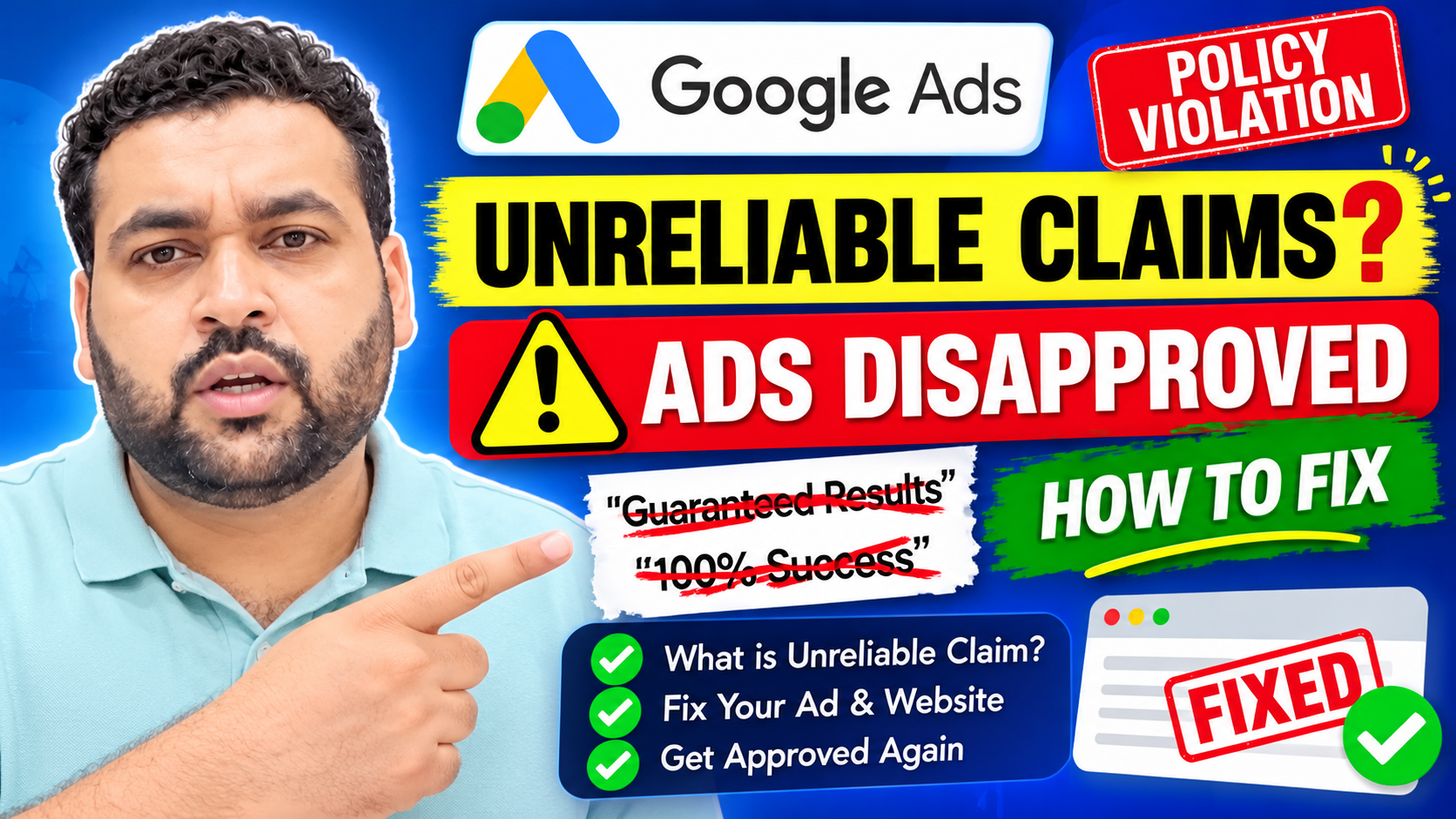
Google Ads Unreliable Claims Disapproved? Here’s How to Fix It
Google Ads showing Unreliable Claims can be frustrating, particularly when you believe everything in your advertisement is true.
But the issue isn’t simply whether an outcome is technically possible.
Google’s policy focuses on whether an advertiser makes an inaccurate claim or presents an improbable outcome as though it is the likely result customers should expect.
Unreliable Claims sits under Google’s broader Misrepresentation policy.
At AARSWEBS, we work with clients facing Google Ads and YouTube Ads policy problems, and this is one of the areas we review.
What Are Google Ads Unreliable Claims?
Consider statements such as:
“Guaranteed #1 ranking.”
“100% success.”
“Lose 10 kg in 30 days.”
“Guaranteed returns.”
“The #1 sales team in America.”
The common problem is certainty without sufficient evidence or an extraordinary outcome being presented as normal.
Before using a claim, ask:
Can we prove it?
Is the evidence independent?
Is this result typical?
Does our wording imply a guarantee?
Google Ads vs Website vs Video
An Unreliable Claims problem can potentially appear in several places.
The Advertisement
Review headlines, descriptions and assets.
The Destination
Check your landing page, homepage and other relevant website content.
Video Advertising
For YouTube Ads, listen to what is actually said inside the video.
On-screen graphics and captions also matter.
This means changing one Google Ads headline may not resolve the issue if the same promise appears elsewhere.
Health & Weight-Loss Claims
Health-related advertising deserves particular attention.
Claims surrounding dramatic weight loss, miracle cures or exceptional medical outcomes can create policy problems.
For example:
“Eat whatever you want and lose 10 pounds this month.”
An advertiser should not present an exceptional or improbable outcome as something a normal user should expect.
Testimonials Aren’t a Loophole
Imagine changing:
“Lose 10 kg in 30 days.”
into:
“A customer says they lost 10 kg in 30 days.”
The second version may accurately quote somebody’s experience.
But that doesn’t automatically solve the policy problem.
Ask:
Is the testimonial genuine?
Is this result typical?
Are we making the exceptional result look normal?
Is appropriate qualification visible?
Are we able to support the testimonial?
Testimonials should communicate genuine experiences rather than becoming a way to repeat claims that the advertiser could not otherwise support.
Does “Results May Vary” Fix Everything?
No.
A disclaimer can provide important context.
For example:
“Individual results may vary. No specific result is guaranteed.”
But an advertiser shouldn’t use a disclaimer to protect a clearly misleading headline.
The overall message still needs to be accurate.
Claims of Being “#1”
Businesses often like to say:
“We’re number one.”
The obvious question is:
According to whom?
If an independent award or ranking supports the statement, explain it clearly.
If no reliable evidence exists, a more objective statement may be safer.
For example:
“Serving customers since 2012.”
Or:
“Trusted by X customers.”
provided those statements can actually be substantiated.
How We Review Unreliable Claims Cases
Depending on the advertiser, our review can include:
- Search ad copy
- Assets
- Landing pages
- Website content
- Testimonials
- Guarantees
- Statistics
- Awards
- Pricing claims
- Refund policies
- YouTube creative
- Related compliance issues
We want to understand what the customer sees throughout the complete journey.
Step 1: Identify the Exact Violation
Open the affected advertisement inside Google Ads.
Check the policy details.
Confirm that the issue is actually Unreliable Claims.
Do not assume every Misrepresentation policy problem has the same solution.
Step 2: Audit the Ad Copy
Search for wording such as:
Guaranteed.
100%.
Number one.
Instant.
Permanent.
Risk-free.
Best.
Always.
Those words aren’t automatically banned.
Their context and supporting evidence matter.
Step 3: Review the Destination
Now search the website for similar promises.
Sometimes the Google Ad is perfectly reasonable while the landing page makes much stronger claims.
Step 4: Review Testimonials
Make sure customer testimonials are genuine and aren’t being framed in a way that implies extraordinary outcomes are normal.
Add clear qualifications where appropriate.
Step 5: Review Video Creative
For YouTube Ads, watch the entire video as though you were Google’s reviewer.
Listen carefully to spoken claims.
Read every text overlay.
Review captions.
Step 6: Correct the Problem
Remove unsupported statements.
Rewrite exaggerated claims.
Use verifiable information.
Add relevant disclaimers or supporting information where needed.
Step 7: Request Review
Once the ad or destination is corrected, allow Google to review it again.
If you genuinely believe Google’s policy decision was incorrect, use the official appeal process.
Can This Become an Account Suspension?
Google’s current Unreliable Claims policy generally gives advertisers warning before account-level suspension rather than immediately suspending the account.
That doesn’t mean advertisers should ignore repeated violations.
Fix policy problems rather than continuously recreating rejected ads.
Need Help With Google Ads Unreliable Claims?
AARSWEBS is a Google Partner company providing assistance with:
- Google Ads Disapprovals
- Unreliable Claims
- Misrepresentation
- Google Ads Suspension
- YouTube Ads Disapprovals
- Google Ads Management
- Advertiser Verification
Our role is to investigate the advertising and destination, identify issues and help prepare the account for review.
Google makes the final approval decision.
Final Thoughts
When an ad is disapproved for Unreliable Claims, don’t ask:
“What wording trick gets around the policy?”
Ask:
“What expectation am I creating for the customer, and can I support it?”
That is a much stronger foundation for both advertising compliance and customer trust.
— Ali Raza
AARSWEBS