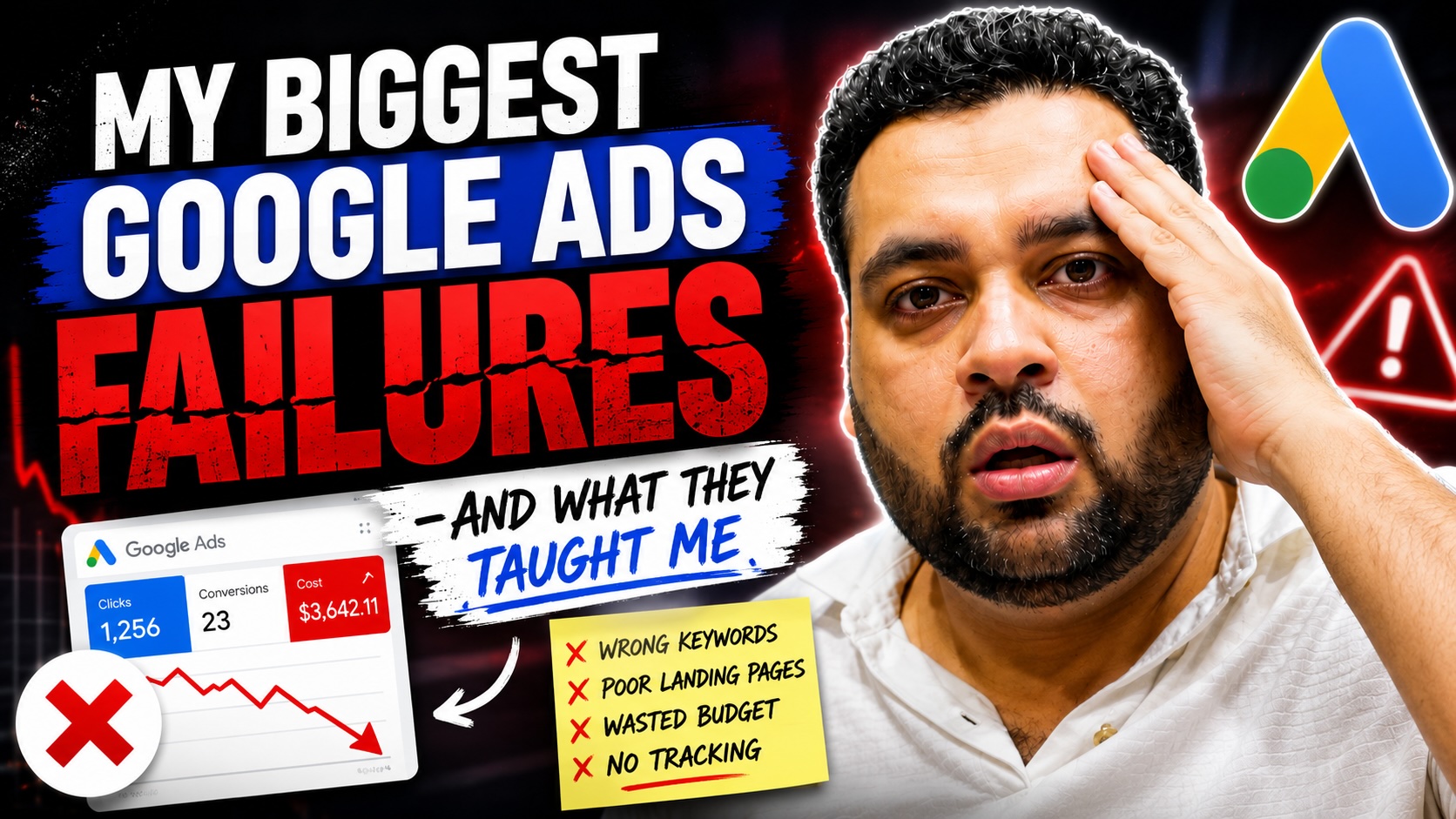
The Google Ads Campaign That Humbled Me: Lessons from 18 Years of PPC Management
People frequently ask digital marketers to share their biggest wins.
They want to hear about:
- Revenue growth
- High return on ad spend
- Successful account recoveries
- Lower cost per lead
- Scaling campaigns
- Record sales months
Those stories are useful.
However, the campaigns that teach us the most are often the ones that struggle.
A recent question asked me:
“Which Google Ads campaign humbled you? What niche was it? How much money did you burn? How long did you believe it would eventually work? Did you recover the account or rebuild everything?”
After more than 18 years in digital marketing, I cannot reduce that answer to one perfect disaster story.
Several campaigns taught me different lessons about patience, business economics, account structure and seasonality.
The three examples below stand out.
Important Transparency Note
The original discussion did not include:
- The precise advertising spend
- The exact amount lost
- The exact number of months each campaign ran
- The client’s full revenue or profit figures
Those numbers should not be invented to make the story more dramatic.
The useful lessons come from what actually happened—not from fictional statistics.
Campaign One: The Shilajit Ecommerce Client
One memorable client operated in the US health-product market and sold Shilajit.
The relationship did not begin with ordinary campaign management.
The client’s Google Merchant Center account had been suspended.
Our initial task was to help resolve the Merchant Center problem and restore the account.
After the recovery, the client expanded the relationship and hired us for:
- Google Ads management
- Merchant Center management
- Ecommerce campaign optimization
The campaign eventually reached approximately break-even performance.
That may sound disappointing.
However, break-even is not always the same as failure.
Why Break-Even Can Be More Complicated Than It Looks
A campaign can appear to break even at the first-order level while still creating longer-term value.
For example, a business may gain:
- Repeat customers
- Email subscribers
- Reviews
- Brand searches
- Word-of-mouth referrals
- Customer lifetime value
- Product feedback
- Market data
However, those benefits only matter when the company can afford to continue operating.
A founder may understand the long-term argument and still be unable to fund another month of advertising.
That is why financial runway matters.
The marketing manager controls only part of the system.
The business owner must also manage:
- Product margins
- Inventory
- Shipping
- Cash flow
- Repeat purchases
- Customer service
- Returns
- Pricing
- Working capital
- Personal risk tolerance
The Shilajit client was motivated at the beginning.
Over time, the client became discouraged.
I attempted to encourage her to continue, but eventually she lost confidence in the process.
That experience taught me that a campaign can be moving in the right direction while the business still reaches its emotional or financial limit.
The Campaign May Need Time—but “Be Patient” Is Not a Strategy
Marketers sometimes use patience as an excuse for poor performance.
They say:
“The algorithm needs more time.”
Sometimes that is true.
Sometimes it is a way to avoid admitting that the strategy is not working.
Patience should be connected to measurable progress.
For example:
- Search-term quality is improving.
- Conversion tracking has become more reliable.
- Conversion rate is increasing.
- Repeat-purchase data is becoming available.
- Cost per customer is moving toward the target.
- Landing-page engagement is improving.
- Better-performing products are being identified.
Without progress, another month of spending may only create another month of loss.
A responsible agency should define:
- What is currently failing?
- What is being changed?
- What result should improve?
- How long will the test run?
- What will cause the strategy to be stopped?
Patience should have checkpoints.
What This Campaign Taught Me
The Shilajit case taught me that Google Ads cannot rescue every weakness in a business.
Advertising cannot permanently compensate for:
- Unsustainable margins
- Weak repeat purchases
- Expensive fulfilment
- Poor inventory availability
- An uncompetitive product
- Limited financial runway
- A founder who no longer trusts the plan
The advertiser and business owner need a shared definition of success.
For one client, break-even may be acceptable while acquiring repeat customers.
For another, break-even may be financially impossible.
Campaign Two: The Account We Considered Rebuilding
Another difficult situation involved a client account with a long history of:
- Poor campaign configuration
- Weak conversions
- Low-quality traffic
- Unhelpful historical data
- Inefficient structure
We initially attempted to improve the existing setup.
We changed and reviewed areas such as:
- Keywords
- Campaign structure
- Advertisements
- Landing-page relevance
- Bidding
- Conversion tracking
- Search terms
- Budget allocation
Eventually, we concluded that continuous repair might be less efficient than rebuilding the structure more fundamentally.
The original discussion described this partly as an account-history and Quality Score problem.
That statement needs an important clarification.
Quality Score Is Not a Documented Account-Level Reputation Score
Google defines the visible Quality Score as a diagnostic score from 1 to 10 that is available at the keyword level.
It is based on:
- Expected click-through rate
- Ad relevance
- Landing-page experience
Google also says Quality Score should be treated as a diagnostic tool rather than a key performance indicator.
Therefore, creating a new account merely to “reset a bad account-level Quality Score” is not a sound general recommendation.
The visible Quality Score does not work like a consumer credit score attached permanently to the entire account.
When a Rebuild Can Still Make Sense
A campaign rebuild can be justified when the existing structure contains serious problems.
Examples include:
- Incorrect conversion actions
- Duplicated conversions
- Unclear campaign objectives
- Several businesses mixed into one structure
- Inconsistent naming
- Broken tracking
- Inappropriate bidding strategies
- Poor keyword organization
- Conflicting location settings
- Legacy campaigns nobody understands
- Account ownership problems
In many cases, the best approach is to rebuild the campaigns inside the existing account.
That preserves:
- Historical reports
- Change history
- Billing continuity
- Audience information
- Conversion data
- Administrative ownership
A completely new account should have a legitimate operational reason.
It should not be treated as a shortcut for escaping poor performance.
Rebuilding Is Not the Same as Starting Without a Strategy
A rebuild should begin with a written plan.
Phase One: Measurement
Confirm:
- Primary conversions
- Secondary conversions
- Call tracking
- Revenue values
- Offline outcomes
- Attribution
- Duplicate tags
Phase Two: Structure
Separate campaigns by:
- Business objective
- Location
- Service
- Product economics
- Brand and non-brand intent
- Budget requirement
Phase Three: Traffic
Review:
- Keywords
- Search terms
- Match types
- Negative keywords
- Audiences
- Locations
- Devices
Phase Four: Experience
Align:
- Keyword
- Advertisement
- Landing page
- Offer
- Call to action
- Conversion event
Phase Five: Bidding
Choose the bid strategy according to:
- Conversion data
- Business objective
- Budget
- Sales cycle
- Conversion value
- Traffic volume
A clean structure is useful only when the underlying strategy is also improved.
Campaign Three: The Seasonal Savings Business
Another campaign taught me how badly annual averages can hide seasonal behaviour.
The client operated in the savings-account market.
Performance was strongest during:
- January
- February
- March
After that, new account openings slowed.
The original approach spread the budget too evenly across the year.
The improved strategy was to:
- Spend more during the high-intent months
- Reduce acquisition pressure during weaker periods
- Maintain lighter brand visibility
- Prepare creative and budgets before the seasonal peak
- Compare performance year over year
Why the Beginning of the Year Was Stronger
The business observed stronger savings interest after the holiday period and around New Year financial goals.
That is a case-specific explanation based on the client’s performance.
It should not be assumed to apply identically to every financial advertiser or country.
The important lesson was not simply:
“Spend more every January.”
The real lesson was:
“Find the months when your own customers are most likely to act.”
Smart Bidding and Seasonality
Google says Smart Bidding normally accounts for regular seasonal performance patterns.
In most situations, advertisers do not need to manually tell the system about ordinary recurring seasonality.
Google’s seasonality adjustments are designed for short, predictable conversion-rate changes—typically unusual events such as brief promotions or sales. Google’s guidance generally positions them for temporary events lasting around one to seven days rather than entire slow or busy seasons.
Therefore, a three-month high season is normally better addressed through:
- Annual budget planning
- Campaign forecasts
- Historical analysis
- Service demand
- Creative planning
- Bidding targets
- Capacity planning
It should not automatically be treated as a short Smart Bidding seasonality adjustment.
What All Three Campaigns Had in Common
The industries were different.
The challenges were different.
However, each case revealed the same broader truth:
Google Ads performance is not controlled only inside Google Ads.
The Shilajit campaign was influenced by:
- Business runway
- Client confidence
- Product economics
- Ecommerce maturity
The poorly configured account was influenced by:
- Historical setup decisions
- Tracking quality
- Campaign architecture
- Measurement
The savings campaign was influenced by:
- Customer seasonality
- Budget timing
- Annual planning
- Market behaviour
The account interface showed the symptoms.
The actual causes extended beyond the interface.
Optimization Rabbit Holes to Avoid
When a campaign struggles, advertisers often disappear into endless tactical changes.
Common rabbit holes include:
- Changing bidding strategies every week
- Pausing and reactivating keywords repeatedly
- Obsessing over the visible Quality Score
- Creating too many tiny campaigns
- Rewriting advertisements without fixing the offer
- Changing budgets without understanding demand
- Blaming the landing page without reviewing traffic
- Blaming traffic without testing the landing page
- Opening a new account without solving the underlying issue
Activity can create the feeling of progress.
It is not always progress.
Every optimization should answer:
- What problem are we solving?
- What evidence supports the change?
- Which metric should improve?
- How long will we evaluate it?
- What result will prove us wrong?
How to Know the Strategy Itself Is Wrong
A strategy may need to be replaced when:
The Economics Cannot Work
Even an excellent conversion rate would not produce an acceptable customer-acquisition cost.
The Search Demand Is Wrong
People are searching for information rather than the commercial offer.
The Product Is Not Competitive
Competitors offer stronger pricing, proof, delivery or features.
The Conversion Data Is Misleading
The campaign is optimizing toward weak actions instead of revenue.
The Structure Prevents Control
Profitable and unprofitable services share the same budget and bidding targets.
Seasonality Is Ignored
The campaign attempts to force demand during periods when customers are not ready.
The Client Cannot Fund the Learning Period
The theoretically correct long-term plan is not operationally possible.
Recognizing these conditions is not admitting defeat.
It is responsible management.
Did We Recover or Rebuild?
The answer differed by case.
Shilajit Client
We helped restore Merchant Center and managed the account toward approximately break-even performance.
The larger limitation became business confidence and runway.
Poorly Configured Account
We attempted optimization and then considered a more fundamental rebuild.
The valuable lesson was to rebuild for structural reasons—not because of a mythical account-wide Quality Score reset.
Savings Business
The account did not require complete abandonment.
The budget and timing strategy needed to change.
More investment was directed toward high-demand periods, with lighter activity during slower months.
What 18 Years of Google Ads Has Taught Me
1. Winning Campaigns Can Still Become Failed Businesses
Advertising performance is only one part of company economics.
2. Break-Even Needs Context
Break-even may be acceptable for customer acquisition with strong lifetime value—or unacceptable for a company with limited cash.
3. Client Patience Has a Financial Limit
“Wait longer” is not useful advice without milestones.
4. Account Structure Matters
A badly organized account can make every optimization slower and less reliable.
5. Quality Score Is a Diagnostic
Do not build the entire strategy around maximizing a 1-to-10 number.
6. Seasonality Can Resemble Failure
A strong campaign can appear weak when measured during naturally low-demand months.
7. The Business Owner Sees a Bigger Picture
The agency manages advertising.
The owner manages inventory, payroll, margins, operations and risk.
8. Failure Creates Better Questions
A win tells you what worked once.
A difficult campaign forces you to understand why.
Questions to Ask Before Spending More
Before increasing the budget, ask:
- Are conversions being tracked correctly?
- Are the leads or sales profitable?
- Which products generate margin?
- Which months produce demand?
- Does the client have enough runway?
- Is the website competitive?
- Are repeat purchases included?
- Is the campaign structure understandable?
- Does the bid strategy match the objective?
- What will cause us to stop or change direction?
These questions prevent optimism from becoming uncontrolled spending.
Frequently Asked Questions
What was the exact amount lost in the Shilajit campaign?
The original discussion did not provide the exact advertising spend or financial loss.
How long did the campaign run?
No precise number of months was provided.
Was the Shilajit campaign a complete failure?
Not necessarily. It reportedly reached approximately break-even performance, but the client lost confidence and did not continue with the same level of commitment.
Is break-even Google Ads performance acceptable?
It depends on customer lifetime value, repeat purchases, margins, cash flow and the company’s objectives.
Can a Google Ads account have a bad account-level Quality Score?
Google’s visible Quality Score is a keyword-level diagnostic. Google does not describe it as a visible account-wide reputation score.
Should I create a new Google Ads account when performance is poor?
Usually not merely because performance is weak.
First consider rebuilding the campaign structure, tracking and targeting inside the existing account.
Does Smart Bidding understand seasonality?
Google says Smart Bidding handles ordinary seasonal patterns in most cases. Seasonality adjustments are primarily designed for short, expected conversion-rate changes.
When should a campaign be stopped?
Consider stopping or replacing the strategy when the economics cannot work, tracking remains unreliable, demand is unsuitable or agreed performance checkpoints repeatedly fail.
Can AARSWEBS audit a struggling Google Ads account?
AARSWEBS provides Google Ads auditing, setup, management, Merchant Center support and broader digital marketing services.
Final Thoughts
The campaigns that humbled me were not necessarily the ones with the largest visible loss.
They were the ones that revealed how little control an advertiser has when the wider business is not aligned.
One client needed more runway.
Another account needed a structural reset.
Another business needed a seasonal budget rather than equal monthly spending.
The deepest lesson from more than 18 years in this field is:
Not every Google Ads problem can be solved with another Google Ads optimization.
Sometimes you need to change:
- The business expectation
- The account architecture
- The measurement
- The budget calendar
- The offer
- The strategy itself
The failures matter because they improve the decisions we make for the next client.
Need Help Diagnosing a Google Ads Campaign?
AARSWEBS provides:
- Google Ads audits
- Search campaign management
- Ecommerce advertising
- Merchant Center support
- Conversion-tracking reviews
- Performance Max management
- Seasonal planning
- Google Business Profile management
- SEO
- Website and landing-page support
Visit AARSWEBS.com to discuss your account.
Disclaimer
This article provides educational information based on anonymized experiences.
Every business and Google Ads account is different. Results depend on the industry, budget, margins, offer, competition, tracking, website and sales process.
No specific sales, revenue or return can be guaranteed.