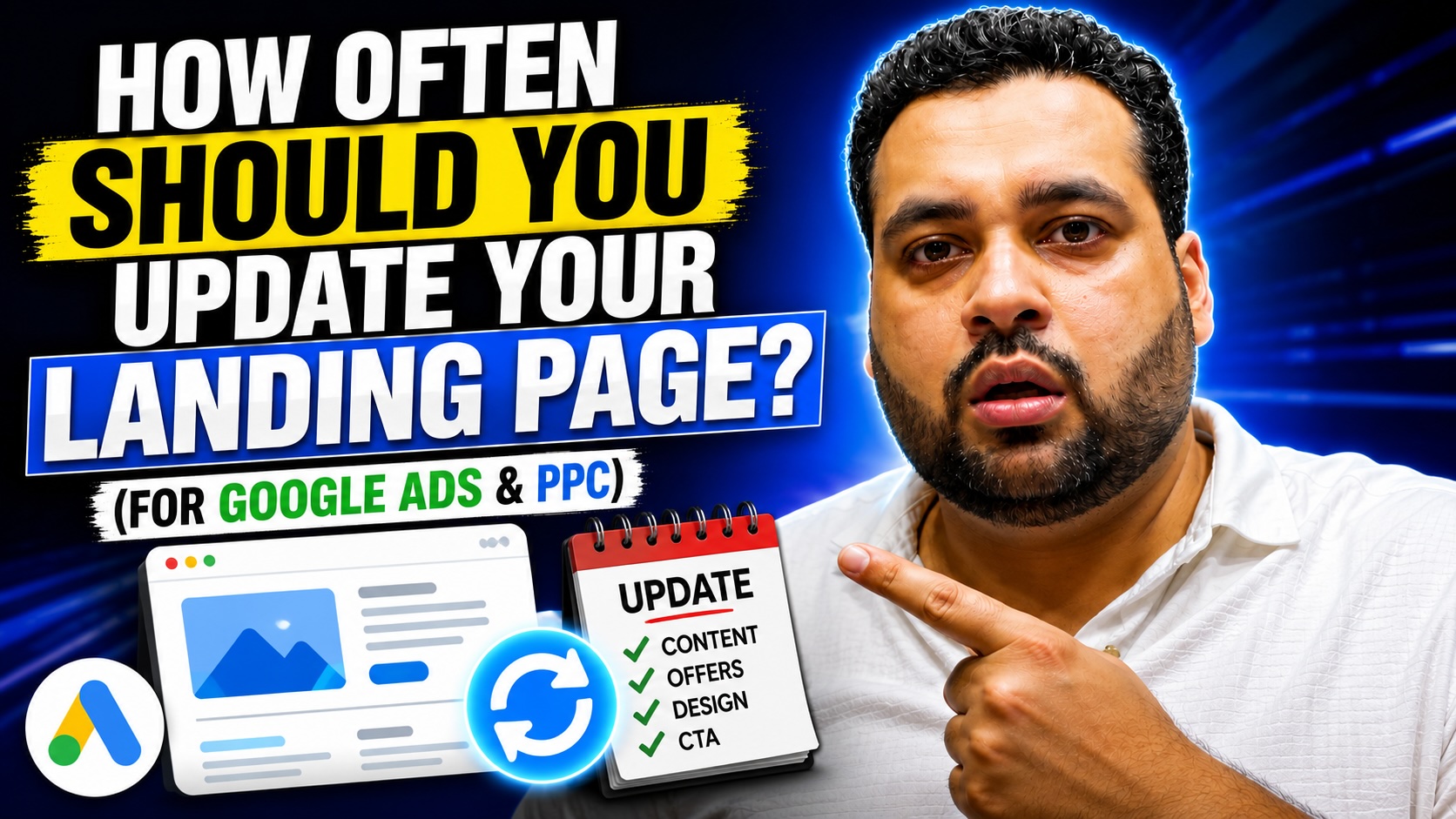
Am I Annoying My Developer by Requesting Too Many Landing Page Changes?
A non-technical founder recently asked an interesting question:
“Am I being annoying if I keep asking my developer to make changes to the same landing page?”
The developer had completed and launched the page.
However, after the advertising campaign started running, the founder continued noticing problems:
- The headline did not fully match the advertisement.
- One section felt out of place.
- The call to action did not feel convincing.
- Visitors were browsing but not submitting the form.
- The conversion rate was below expectations.
Every new observation created another message to the developer.
The founder would explain the change, wait for it to be implemented, review it and then discover something else.
Eventually, the founder began worrying that the developer was tired of revising a page that was supposed to be finished.
At the same time, ignoring obvious conversion problems did not feel responsible.
So, which fear is correct?
Are repeated landing-page revisions a normal part of marketing, or are they the behaviour of a difficult client?
You Are Not Annoying for Caring About Conversions
A landing page is not merely a design deliverable.
It is a commercial tool.
Its purpose may be to generate:
- Form submissions
- Telephone calls
- Bookings
- Purchases
- Demonstration requests
- Consultation requests
- Software registrations
- Trial sign-ups
When the page does not accomplish that objective, it is reasonable to investigate why.
A developer may have produced a technically functional and visually attractive page.
That does not automatically mean the page will convert every advertising audience.
The developer may not have known:
- Which keywords would trigger the advertisements
- Which promises appeared in the advertisements
- Which objections customers commonly raised
- Which devices would generate most of the traffic
- Which competitors would appear beside the advertisement
- How much information a visitor needed before converting
- Which leads the sales team considered qualified
Many conversion problems only become visible after real people begin interacting with the page.
Requesting evidence-based revisions is not unreasonable.
The problem begins when the revision process has no structure.
A Landing Page Is Not Finished at Launch
Launch is the beginning of the measurement process.
Before launch, the page is based on:
- Research
- Experience
- Assumptions
- Customer interviews
- Competitor analysis
- Design principles
- Previous campaign results
After launch, the business begins collecting real behavioural and commercial evidence.
That evidence may show that:
- Visitors misunderstand the offer.
- The advertisement and landing-page headline do not match.
- The form appears too late.
- Mobile visitors cannot use a field.
- The CTA is easy to overlook.
- The page lacks trust.
- The price creates uncertainty.
- The service area is unclear.
- The page attracts the wrong type of enquiry.
Google recommends closely aligning advertisements, keywords and landing pages. Google also describes landing-page experience in terms of relevance, usefulness, ease of navigation and whether the page fulfils expectations created by the advertisement.
A page may therefore be technically “complete” while still being commercially ineffective.
The Headline Must Match the Advertisement
Suppose the advertisement promises:
“Google Ads Management for Local Service Businesses”
The landing-page headline says:
“Complete Digital Solutions for Modern Companies”
The second headline may sound professional.
However, it does not continue the specific conversation started by the advertisement.
The visitor clicked because they wanted help with Google Ads for a local business.
They should immediately see confirmation that they have reached the correct place.
A stronger headline could be:
“Google Ads Management for Local Service Businesses That Need Better Leads”
The advertisement and page now share:
- The same service
- The same audience
- The same commercial objective
- The same language
This principle is known as message matching.
When a founder notices that the headline does not match the advertisement, requesting a revision is reasonable.
Small Changes Can Matter—but They Must Be Tested
A founder may notice the CTA button, form design or section order and believe a small change will improve conversions.
Sometimes it does.
For example, improving the visibility of a CTA may help visitors understand what to do next.
Changing the CTA text from:
“Submit”
to:
“Request My Free Google Ads Audit”
may make the outcome clearer.
However, no button colour, CTA phrase or layout change is guaranteed to improve conversions universally.
The result depends on:
- Contrast
- Page design
- Visitor intent
- Offer strength
- Device
- Traffic source
- Existing user behaviour
The correct approach is not:
“Blue buttons always convert better.”
It is:
“The current CTA may not be visible enough. Let us test a clearer design and measure the result.”
A conversion optimization process transforms preferences into hypotheses.
Use Evidence Before Requesting Changes
The founder in the original question was already using visitor recordings.
That is a positive step.
Microsoft Clarity session recordings can recreate actions including clicks, taps, scrolling, page visits and navigation. They can help teams see where visitors struggle, which content they engage with and whether a technical issue interrupts the journey.
Useful evidence may come from:
- Google Ads search terms
- Google Ads keyword performance
- Conversion tracking
- GA4
- Microsoft Clarity
- Heatmaps
- Form analytics
- Call recordings
- Sales-team feedback
- Customer interviews
- Device reports
- Page-speed reports
For example:
Weak Request
“Move the form higher because I think it looks better.”
Stronger Request
“Seventy percent of mobile visitors do not reach the current form section. I want to test a shorter form directly below the main offer.”
The second request gives the developer context.
It also provides a way to determine whether the change worked.
Session Recordings Are Not the Complete Answer
Visitor recordings are valuable, but they need interpretation.
Watching one person fail to click a button does not prove that the button is the primary conversion problem.
The visitor may have:
- Arrived through an irrelevant keyword
- Been outside the service area
- Expected a lower price
- Been researching rather than buying
- Opened the page accidentally
- Planned to return later
- Converted through a telephone call instead
Look for repeated patterns across relevant visitors.
Segment recordings by:
- Traffic source
- Campaign
- Device
- Landing page
- Country
- Conversion status
- Session duration
- New or returning visitor
Microsoft currently retains standard Clarity recordings for 30 days, while selected favourite recordings can be retained longer. Save or document important examples before they disappear.
When Landing Page Changes Are Reasonable
You should consider revising the page when there is evidence that:
The Advertisement and Page Do Not Match
The advertisement promotes one message, but the landing page starts a different conversation.
Visitors Misunderstand the Offer
The page does not clearly explain what the customer receives, who the service is for or what happens next.
The CTA Is Weak or Difficult to Find
Visitors engage with the page but do not know what action to take.
The Form Creates Friction
The form may:
- Ask for too much information
- Fail on mobile devices
- Display unclear errors
- Request sensitive details too early
- Lack a privacy explanation
The Page Lacks Trust
The visitor may need:
- Customer reviews
- Case studies
- Credentials
- Service guarantees
- Real team photographs
- Business contact details
- Transparent pricing information
- Clear policies
The Page Is Too Generic
Different services, keywords or customer intentions may require different pages.
A person searching for “Google Ads suspension help” has a different immediate problem from someone searching for “monthly Google Ads management.”
Sending both users to one generic agency page may weaken relevance.
The Page Has Technical Problems
Examples include:
- Slow loading
- Broken forms
- Missing mobile buttons
- Overlapping elements
- Tracking errors
- Broken links
- Redirect problems
Google Ads includes a Landing Pages report that can help advertisers evaluate page performance and identify pages that may provide a weaker mobile experience.
When You Should Stop Requesting Random Changes
Landing-page optimization does not mean changing something every day.
Pause revisions when:
You Do Not Have Enough Traffic
A page with ten visitors cannot reliably tell you whether one headline is better than another.
Conversion Tracking Is Broken
You cannot optimize a page when the business does not know which visitors converted.
Too Many Changes Are Already Active
When the headline, form, offer, CTA and pricing are changed simultaneously, you may see a result without knowing what caused it.
The Traffic Is Irrelevant
A perfect page cannot convert visitors who are looking for another service.
Review Google Ads search terms, targeting, locations and keywords before blaming the page.
The Offer Is the Real Problem
A new design cannot rescue an offer that customers do not want, trust or understand.
Changes Are Based Only on Personal Taste
Statements such as these are not conversion evidence:
- “I do not like the colour.”
- “This section feels boring.”
- “My friend preferred another layout.”
- “A competitor uses a different button.”
Personal judgment can create a hypothesis.
It should not automatically become an instruction.
The One-Change-at-a-Time Problem
Sending every observation to a developer immediately creates avoidable inefficiency.
The developer has to:
- Read the request.
- Understand the context.
- Ask questions.
- Open the project.
- Make the change.
- Test the change.
- Deploy it.
- Wait for feedback.
- Repeat the process.
Even a five-minute visual change can interrupt more important development work.
The founder also loses time writing, waiting and reviewing.
The solution is not to stop making changes.
The solution is to create a better revision system.
Create a Landing Page Optimization Backlog
Use a shared document, spreadsheet or project-management system.
Each suggested change should include:
| Field | What to include |
|---|---|
| Problem | What is not working? |
| Evidence | What data supports the concern? |
| Hypothesis | Why might the proposed change help? |
| Proposed change | What should be changed? |
| Priority | How important is it? |
| Effort | How difficult is implementation? |
| Metric | How will success be measured? |
| Status | Proposed, approved, developing, testing or complete |
Example
Problem: Mobile visitors reach the pricing section but rarely begin the form.
Evidence: Session recordings show repeated scrolling between pricing and FAQs.
Hypothesis: Visitors may need a clearer next step and reassurance before sharing details.
Proposed change: Add a short testimonial, privacy statement and CTA above the form.
Success metric: Increase qualified form submissions without increasing spam.
This makes the request easier for the developer and more useful for the business.
Batch Related Revisions
Instead of contacting the developer five times during the week, collect related requests and submit them together.
A possible schedule is:
Weekly
Use weekly batches for:
- Broken elements
- Urgent tracking errors
- Incorrect text
- Form problems
- Time-sensitive offers
Every Two Weeks
Use biweekly batches for:
- Copy improvements
- CTA tests
- Section changes
- Trust elements
- Mobile layout improvements
Monthly
Use monthly reviews for:
- Larger page variations
- New service pages
- Major offer changes
- Design-system updates
- Conversion strategy
The correct schedule depends on traffic, budget and development resources.
Separate Bugs from Experiments
Not every revision should follow the same process.
Bugs
A broken form should be fixed immediately.
It does not require an A/B test.
Compliance and Accuracy Issues
An incorrect price, expired offer or misleading statement should be corrected immediately.
Conversion Hypotheses
A new headline, CTA, section order or form length can be tested.
Personal Preferences
These should normally receive the lowest priority unless they create a real brand or usability problem.
This classification prevents urgent problems from becoming lost among cosmetic requests.
Test One Important Hypothesis at a Time
Google Ads custom experiments can be used to test landing pages and compare the result against the existing campaign by splitting traffic or budget.
Testing one meaningful hypothesis at a time makes the result easier to interpret.
For example:
Test One
Original headline versus a keyword-matched headline.
Test Two
Long form versus shorter form.
Test Three
General testimonial versus service-specific case study.
Avoid launching all three changes together when you need to know which one caused the improvement.
Create Different Pages for Different Intentions
Sometimes revising one page repeatedly is not the best solution.
The business may need separate pages.
For example, AARSWEBS may have visitors searching for:
- Google Ads management
- Google Ads audit
- Conversion tracking
- Landing-page CRO
- Google Ads suspension help
- Merchant Center suspension help
Each visitor has a different problem.
A dedicated landing page can use:
- A more relevant headline
- Specific evidence
- Matching case studies
- A focused CTA
- Appropriate FAQs
- Relevant pricing or process information
This does not mean creating a separate page for every minor keyword variation.
Group closely related intentions into clear service themes.
Agree on Revision Scope Before Development
Many conflicts occur because the founder and developer have different definitions of “finished.”
The agreement should explain:
- How many initial revision rounds are included
- What counts as a minor revision
- What counts as a new feature
- What counts as a new landing page
- The cost of revisions after launch
- Expected turnaround
- Emergency-fix procedures
- Who provides copy and design
- Who performs QA
- Who monitors conversion data
A minor revision might involve:
- Replacing a headline
- Changing CTA text
- Moving an existing section
- Updating an image
A new project might involve:
- Rebuilding the design
- Creating a calculator
- Adding a customer portal
- Developing a multi-step form
- Creating a completely new landing page
“Unlimited revisions” should not be interpreted as unlimited redevelopment.
Use a Staging Environment
Changes should be reviewed before being placed on the live page.
A staging process can include:
- Developer implements the approved batch.
- Founder reviews the staging link.
- Team checks desktop and mobile versions.
- Forms and tracking are tested.
- Errors are corrected.
- Changes are published.
- Performance is monitored.
This reduces repeated deployment and helps prevent broken live pages.
Create a Landing Page QA Checklist
Before approving changes, review:
Copy
- Does the headline match the advertisement?
- Is the offer clear?
- Are claims accurate?
- Is the CTA specific?
- Are spelling and grammar correct?
Design
- Is the main CTA visible?
- Does the page work on mobile?
- Is important text readable?
- Are sections easy to scan?
- Do images support the offer?
Forms
- Does the form submit?
- Are error messages clear?
- Is the confirmation page working?
- Is spam protection functioning?
- Are leads reaching the correct team?
Tracking
- Does the conversion fire once?
- Are telephone calls tracked?
- Is GA4 recording the event?
- Does Google Ads receive the conversion?
- Are test leads excluded from sales reporting?
Trust
- Are reviews genuine?
- Are business details accurate?
- Are privacy and policy links working?
- Are guarantees explained?
- Are contact methods visible?
What Developers Need from Founders
Developers usually do not object to meaningful improvements.
They become frustrated by:
- Vague instructions
- Contradictory feedback
- Constant priority changes
- Requests without context
- Feedback from several uncoordinated people
- New features described as small revisions
- Changes approved and reversed repeatedly
A strong request gives the developer:
- The objective
- The evidence
- The exact page
- The affected device
- The desired behaviour
- The priority
- The deadline
- The acceptance criteria
For example:
“On mobile, the sticky CTA covers the final form button. Please adjust it so the submit button remains visible on common screen sizes. This is a high-priority bug.”
That is easier to execute than:
“The mobile page still feels wrong.”
What Founders Need from Developers
The responsibility is not entirely on the founder.
A developer should also communicate:
- Whether a request is simple or complex
- Whether it affects another feature
- Whether the design creates accessibility concerns
- Whether the requested change could damage mobile usability
- Whether implementation requires additional cost
- When the work can be completed
- How the change should be tested
A productive relationship requires both sides to understand the commercial objective and technical constraints.
When to Hire a CRO-Focused Marketing Team
A standalone developer may be excellent at development but may not be responsible for:
- Google Ads strategy
- Keyword research
- Search-term quality
- Conversion tracking
- Session-recording analysis
- Competitor research
- Lead-quality evaluation
- Conversion testing
When landing-page work is closely connected with paid advertising, a CRO-focused PPC team can coordinate the entire journey.
AARSWEBS currently provides Google Ads management with conversion-tracking reviews, CRO guidance, landing-page analysis, lead-quality review, competitor research and fraud-click protection setup. Development and page implementation depend on the selected service and agreed scope.
This coordination can reduce the common situation where:
- The advertising manager blames the landing page.
- The developer blames the traffic.
- The founder acts as the messenger between both sides.
- No one owns the complete conversion journey.
A Better Workflow for Founders
Follow this process:
Step 1: Confirm Tracking
Make sure form submissions, calls, bookings and sales are measured correctly.
Step 2: Review Traffic Quality
Examine search terms, keywords, locations, devices and audiences.
Step 3: Study Behaviour
Use session recordings, analytics and form data to identify patterns.
Step 4: Build a Backlog
Document every proposed change rather than sending it immediately.
Step 5: Prioritize
Focus first on changes likely to have the greatest commercial impact.
Step 6: Batch Requests
Send an organized package to the developer.
Step 7: Test on Staging
Review functionality before publishing.
Step 8: Measure
Compare conversion rate, qualified leads, cost per lead and sales.
Step 9: Document the Result
Record what changed and what happened.
Step 10: Repeat
Continue only when new evidence supports another test.
Frequently Asked Questions
Is it normal to change a landing page after launch?
Yes.
Real advertising and visitor data often reveal problems that were not obvious during the design process.
Am I annoying my developer by asking for revisions?
Not when the revisions are organized, within the agreed scope and supported by a clear business reason.
Sending vague, contradictory requests one at a time can become inefficient.
How often should a landing page be updated?
There is no universal schedule.
Urgent bugs should be fixed immediately. Conversion changes may be reviewed weekly, biweekly or monthly depending on traffic and resources.
Should I change the page whenever conversions decline?
No.
First check advertising traffic, tracking, seasonality, device mix and lead quality.
Can changing a CTA colour increase conversions?
It can improve visibility in a particular design, but no colour universally guarantees more conversions. Test the complete CTA experience, including contrast, wording and placement.
Should every Google Ads campaign have its own landing page?
Not necessarily.
Create separate pages when campaigns represent meaningfully different services, audiences, offers or intentions.
Are Microsoft Clarity recordings useful?
Yes. They can show clicks, scrolling, taps and navigation behaviour, helping teams identify friction and technical problems.
Can Google Ads test different landing pages?
Google Ads custom experiments can be used to test landing pages and other campaign changes.
Should I ask for unlimited revisions?
Clarify exactly what “unlimited” includes.
Revisions to an existing design are different from creating new functionality or rebuilding the page.
Does AARSWEBS provide landing-page support?
AARSWEBS provides landing-page CRO guidance and audits alongside Google Ads, conversion-tracking and lead-quality services. Development and implementation depend on the agreed package and scope.
Final Verdict
You are not an annoying client merely because you believe the landing page can perform better.
A landing page should evolve when real evidence reveals:
- Message mismatch
- User confusion
- Form friction
- Weak trust
- Technical problems
- Poor mobile experience
- Different audience intentions
However, constantly sending isolated requests is inefficient for both the founder and developer.
The smarter approach is to:
- Collect evidence.
- Create an optimization backlog.
- Prioritize by impact.
- Batch related revisions.
- Separate bugs from experiments.
- Test important hypotheses.
- Measure qualified conversions.
- Document the result.
Do not treat your landing page as untouchable.
Also, do not treat it as a canvas that must change whenever someone has a new opinion.
Treat it as a measurable part of your customer-acquisition system.
Need Help Improving Google Ads and Landing Page Conversions?
AARSWEBS provides:
- Google Ads campaign management
- Landing-page CRO audits
- Conversion-tracking reviews
- Lead-quality analysis
- Search-term optimization
- Competitor research
- Fraud-click protection setup
- Mobile CTA and form reviews
- Google Ads audits
- Ongoing optimization guidance
Visit AARSWEBS.com to discuss your campaign.
Disclaimer
AARSWEBS is an independent Google Partner digital marketing agency.
Conversion results depend on the offer, market, traffic, budget, website, tracking and sales process. No specific number of leads, sales or conversion-rate improvement can be guaranteed.