Google Ads Unacceptable Business Practices Suspension Recovery Case Study [2026]
A Google Ads account suspension can immediately disrupt a business that depends on paid search for enquiries, bookings, and sales.
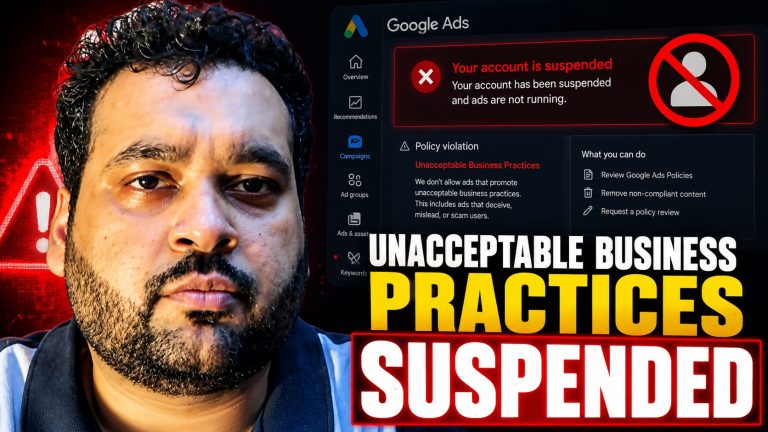
In this case study, we examine an established Umrah travel business whose Google Ads account was suspended for Unacceptable Business Practices.
According to the case materials, the company had operated for approximately 17 years, held relevant travel-industry credentials, and had used Google Ads successfully before the suspension occurred.
The client attempted to recover the account independently. After several rejected appeals, the company approached AARSWEBS for a more comprehensive review.
The account was eventually reinstated after a detailed audit, multiple rounds of website corrections, supporting documentation, and a carefully prepared appeal.
This article explains what we found, what was changed, and what other advertisers can learn from the case.
Case Study Overview
| Case detail | Information |
|---|---|
| Industry | Umrah travel and pilgrimage packages |
| Business history | Approximately 17 years |
| Account status | Suspended |
| Policy | Unacceptable Business Practices |
| Earlier appeals | Six reportedly rejected |
| Main audit areas | Website, packages, policies, technical issues, advertisements, documentation |
| Final result | Appeal successful and account reinstated |
| Important limitation | Reinstatement is never guaranteed |
The account identifier and other private details have been intentionally omitted.
What Is an Unacceptable Business Practices Suspension?
Unacceptable Business Practices falls under Google Ads’ Misrepresentation policy.
Google says advertisers must not hide or misrepresent important information about their businesses, products, services, qualifications, or affiliations.
Examples include:
- Claiming an affiliation that does not exist
- Offering services the advertiser cannot provide
- Hiding the advertiser’s identity
- Misrepresenting qualifications
- Providing misleading or incomplete commercial information
Google classifies this as an egregious policy category. A violation can result in an immediate suspension without prior warning. Google may consider advertisements, websites, connected accounts, and third-party information when reviewing the advertiser. (support.google.com)
This means fixing one advertisement may not be enough.
The review may need to include the entire customer journey:
Advertisement → landing page → business details → offer → payment or enquiry process
A Legitimate Business Can Still Face a Suspension
One of the most important lessons from this case is that an established business can still have compliance problems.
The client reportedly had:
- A long operating history
- Travel-industry credentials
- Existing customers
- A functioning website
- A history of advertising
- Supporting documentation
However, legitimacy alone does not guarantee that every advertisement and website page meets Google’s current requirements.
A genuine company may still create risk through:
- Outdated information
- Conflicting contact details
- Unclear package inclusions
- Incorrect pricing
- Expired offers
- Generic policy pages
- Technical errors
- Different information across domains
- Missing qualification evidence
In this case, the audit focused on how clearly and consistently the business presented itself to users and Google.
Why the Entire Website Needed to Be Reviewed
The suspension message identified Unacceptable Business Practices, but it did not provide a complete list of every website problem.
That meant the team could not simply change one sentence and submit another appeal.
Google states that it may review information from several sources, including the advertisement, website, account, and third-party sources. (support.google.com)
Our process therefore examined:
- Main website pages
- Landing pages
- Package pages
- Business policies
- Contact information
- Social profiles
- Pricing claims
- Advertisements
- Technical performance
- Security
- Search Console
- Supporting business documents
The objective was not to guess one isolated trigger.
The objective was to remove avoidable ambiguity across the entire customer experience.
Issue 1: Unclear Flight Inclusions and Exclusions
Some package pages contained information that could confuse a traveller about whether flights were included.
For example, a package might state that flights were excluded while another part of the page referred to a return flight.
Even when this is caused by a template or editing mistake, it can create a misleading impression.
Travel package pages should clearly explain:
- Whether flights are included
- Whether the journey is one-way or return
- Departure airport
- Arrival airport
- Airline, when applicable
- Baggage allowance
- Travel dates
- Transfer arrangements
- Additional fees
This does not mean Google publishes a mandatory field-by-field Umrah package template.
These were case-specific corrections intended to make the commercial offer clear and internally consistent.
Issue 2: Incomplete Package Information
The audit recommended clearer details for each travel package.
Relevant information included:
- Departure airport
- Airline status
- Baggage information
- Hotel name
- Hotel room type
- Distance from key religious sites
- Visa status
- Flight status
- Package dates
- Complete price
- Excluded services
Google’s Misrepresentation policy prohibits hiding important information or presenting products and services in a way that creates a false or misleading impression. It also prohibits misleading pricing practices and unavailable offers. (support.google.com)
For travel advertisers, a clear package summary helps both policy compliance and customer confidence.
Issue 3: Hajj and Umrah Content Needed Clearer Separation
The website contained Hajj and Umrah-related content that needed clearer organization.
These are distinct services with different:
- Dates
- Regulations
- Packages
- Prices
- Visa requirements
- Travel arrangements
- Customer expectations
Combining them on one landing page without clear separation can create confusion.
The audit recommended dedicated sections or pages so that each advertisement led to information directly relevant to the promoted service.
Issue 4: Expired Packages Remained Visible
Some expired packages were reportedly still available on the website.
An outdated offer can create several problems:
- The advertised date may have passed.
- The price may no longer be available.
- The hotel or flight may no longer be bookable.
- A customer may believe the offer is still current.
- Google may see a mismatch between the advertisement and destination.
Google’s policy prohibits advertising offers that are unavailable or difficult to find on the destination. (support.google.com)
Expired packages should be:
- Removed
- Clearly marked as unavailable
- Redirected to a current alternative
- Updated with accurate dates and pricing
Businesses with frequently changing inventory need a process for reviewing old pages before advertising campaigns are launched.
Issue 5: A Pricing Claim Needed to Be Removed or Clarified
The case materials mention a small pricing claim that required correction or removal.
Even a minor amount can become a policy concern when it is:
- No longer available
- Missing important conditions
- Presented differently elsewhere
- Not clearly connected to the service
- Excluding fees that the customer must pay
Google prohibits pricing practices that create a misleading impression of the complete cost or lead to unexpected charges. (support.google.com)
Every price on an advertisement or landing page should match the actual offer available to the customer.
Issue 6: Conflicting Business Addresses
The privacy policy reportedly displayed a business address that conflicted with information elsewhere on the website.
A difference may be legitimate.
For example, a company may have:
- A registered office
- A customer-facing branch
- A correspondence address
- A fulfilment location
However, the role of each address should be explained.
An unexplained difference can make it harder for users and reviewers to understand:
- Which company operates the website
- Where the business is located
- Where customers should contact it
- Whether the advertiser is the same entity named in the policies
The audit aligned the website’s business information and removed unnecessary contradictions.
Issue 7: Conflicting Telephone Numbers
Different telephone numbers were displayed across the site.
The main header, contact page, package pages, and transport page did not always use the same number.
A business can legitimately have several numbers.
The solution is not necessarily to delete every number except one.
A clearer approach may be:
- Main office: number
- Package bookings: number
- Transport department: number
- Emergency support: number
Every number should be labelled and connected to the same verified business.
Unexplained inconsistencies can reduce user trust and create uncertainty about the advertiser’s identity.
Issue 8: Duplicate or Generic Policy Content
The terms and conditions reportedly contained duplicated or generic material.
Policy pages should accurately describe the real business.
They should not be copied from an unrelated company or include details that do not apply.
Important pages may include:
- Privacy policy
- Terms and conditions
- Cancellation policy
- Refund policy
- Cookie policy
- Contact page
- Company information
- Package conditions
These pages should use consistent:
- Legal business name
- Address
- Contact information
- Jurisdiction
- Service descriptions
- Refund conditions
- Data-handling practices
A generic template is only useful after it has been carefully adapted to the actual company.
Issue 9: Social Media and Contact Information
The team checked whether the website’s social-media links and contact methods worked correctly.
Problems can include:
- Links leading to unrelated profiles
- Empty or abandoned accounts
- Different business names
- Incorrect telephone numbers
- Broken email links
- Non-functional forms
- Missing responses after submission
A broken social link may not independently cause a suspension.
However, several inconsistencies together can weaken trust in the advertiser.
The audit therefore treated the website as a complete trust system rather than a collection of unrelated pages.
Issue 10: Malware and Website Security
The team also performed malware and security checks.
A compromised site can:
- Redirect visitors
- Load malicious scripts
- Display content unknown to the owner
- Send users to a different domain
- Trigger Google Ads security enforcement
- Expose customer information
The audit reviewed the website with malware and security-scanning tools and investigated whether plugins, scripts, or recent changes could be contributing to the problem.
A clean business reputation cannot protect an infected website from enforcement.
Issue 11: Broken Links and Coding Problems
Broken links, coding errors, and non-functional elements were also reviewed.
Technical errors can affect:
- Google’s ability to crawl the page
- The user’s ability to contact the company
- Pricing displays
- Forms
- Navigation
- Mobile usability
- Package availability
- Redirect behaviour
Not every technical error is a suspension trigger.
However, technical quality matters when Google is evaluating whether the destination is reliable, usable, and consistent with the advertisement.
Issue 12: Plugins and Recent Website Changes
The team reviewed:
- Recently installed plugins
- Recent code changes
- Tracking scripts
- Redirects
- Forms
- Website themes
- Campaign changes
- New landing pages
This helped determine whether the suspension followed a particular technical or advertising change.
Maintaining a change log can make this investigation easier.
Record:
- What changed
- Who changed it
- When it changed
- Which pages were affected
- Whether advertisements began using the changed destination
Issue 13: Google Search Console and Recrawling
After making website corrections, the updated content needed to be available for Google to crawl.
The team reviewed Search Console and requested updated indexing where appropriate.
Submitting an appeal immediately after making changes may not always give Google enough time to see the corrected website.
However, requesting indexing does not guarantee an immediate crawl, policy review, or account reinstatement.
It is simply one part of making the latest website version discoverable.
Why the First Audit Was Not the Last Audit
After the initial corrections, the team reviewed the website again and discovered additional pages and policy issues that still needed attention.
This second review was important because large websites often contain:
- Old pages
- Archived packages
- Hidden navigation paths
- Duplicate templates
- Previous contact information
- Forgotten policy text
- Indexable staging pages
A single homepage review is rarely sufficient for a complex suspension.
The case required several rounds of checking before the appeal was prepared.
Supporting Documentation
The client had business and travel-related documentation available.
The case materials mention:
- Company documentation
- Travel credentials
- Authorization letters
- Permissions
- Business history
- Package information
Not all documents were displayed publicly in the video for privacy reasons.
Useful evidence can depend on the business and suspension reason.
It may include:
- Company registration
- Professional licence
- Supplier agreement
- Brand authorization
- Travel accreditation
- Proof of address
- Domain ownership
- Identification
- Payment records
- Advertiser verification documents
Only submit genuine and relevant documentation.
Never alter, fabricate, or misrepresent evidence.
Preparing the Appeal
Google says accounts are reinstated only in compelling circumstances, such as when the original decision was mistaken or the advertiser can demonstrate a valid basis for reinstatement.
Google advises advertisers to be thorough, accurate, and honest. (support.google.com)
A useful suspension appeal should explain:
- What the business does
- Who owns and operates it
- What policy was cited
- What investigation was completed
- What issues were found
- What corrections were made
- What documentation supports the business
- Why the account should now be reviewed
- How future compliance will be maintained
Avoid vague statements such as:
“We did nothing wrong. Please reactivate the account.”
A detailed appeal should demonstrate that the advertiser understands the concern and has completed a serious review.
Do Not Repeatedly Submit the Same Appeal
Submitting several appeals without making meaningful changes can hurt the process.
Google says too many appeals for the same account suspension may not be processed. It recommends submitting one appeal at a time. (support.google.com)
Before reappealing:
- Read the previous response
- Review the policy again
- Check the full website
- Correct remaining issues
- Gather additional evidence
- Improve the explanation
- Confirm that changes are live
A rejected appeal does not automatically mean the account can never be restored.
It does mean the next submission should contain something materially different and relevant.
Never Create Another Account to Bypass the Suspension
Google explicitly warns advertisers not to create new accounts while awaiting a suspension appeal because those accounts may also be suspended. (support.google.com)
Creating or using another account to continue advertising can create a Circumventing Systems concern.
The original recording refers to a separate test account used during the process. That activity is not presented here as a recommended method and should not be copied.
The safe approach is:
- Stop attempting to serve ads through alternative accounts
- Investigate the original suspension
- Correct the underlying problem
- Use Google’s official appeal process
- Provide accurate information
What Google Partner Status Does—and Does Not—Mean
AARSWEBS participates in the Google Partners program.
Google confirms that Partners can receive benefits across:
- Education and insights
- Recognition and rewards
- Access and support (support.google.com)
This can help an agency access support resources and stay informed about Google Ads products.
It does not mean:
- The agency controls Google
- Every suspension will be reversed
- Appeals automatically receive approval
- Policies can be bypassed
- Google Partner status overrides enforcement
Any claim of guaranteed reinstatement should be treated cautiously.
The Final Outcome
After the audit, corrections, documentation, and appeal process, the client received confirmation that the appeal had been successful.
The notice stated that the advertisements could resume as long as no other violations remained.
The client later reported that:
- Six previous appeals had been rejected
- The website was updated using the team’s recommendations
- A further appeal was submitted
- The account was unsuspended
- The team communicated promptly
- The client was satisfied with the service
These statements come from the case-study material and client testimonial. They have not been independently verified by Google.
Google Ads Suspension Recovery Checklist
Business Identity
- Is the legal business name visible?
- Is the advertised name consistent?
- Are qualifications and affiliations accurate?
- Is the business address correct?
- Are telephone numbers clearly labelled?
- Can the company provide supporting documentation?
Advertisements
- Do the advertisements describe an available service?
- Are prices accurate?
- Do promotions have clear conditions?
- Does the final URL lead to the correct page?
- Does the landing page match the advertisement?
- Are business and brand relationships represented honestly?
Website
- Are current services clearly explained?
- Are expired packages removed?
- Are inclusions and exclusions visible?
- Are prices complete?
- Do forms and telephone links work?
- Are policies customized for the business?
- Are contact details consistent?
- Are all important pages accessible?
Technical Review
- Is the website free from malware?
- Are there suspicious redirects?
- Are plugins updated?
- Are there broken links?
- Does the website work on mobile?
- Are pages crawlable?
- Are old domains or landing pages still active?
- Have recent changes been reviewed?
Appeal
- Were the actual issues corrected?
- Is the appeal truthful?
- Does it explain the corrections?
- Is documentation ready?
- Has the advertiser avoided repeated identical appeals?
- Has the advertiser avoided creating another account?
Frequently Asked Questions
What does Unacceptable Business Practices mean in Google Ads?
It is part of Google’s Misrepresentation policy. It covers serious situations in which a business, product, service, affiliation, qualification, or identity is hidden or misrepresented. (support.google.com)
Can Google suspend an account without warning?
Yes. Google classifies Unacceptable Business Practices as an egregious violation that may result in immediate suspension without prior warning. (support.google.com)
Why was an established business suspended?
A long operating history does not automatically mean every advertisement and website page complies with Google Ads policies.
In this case, the audit found inconsistencies involving package information, expired offers, addresses, telephone numbers, policy content, and technical issues.
Can an IATA-accredited travel company be suspended?
Yes. Accreditation may help verify the business, but it does not replace compliance with Google Ads and destination requirements.
How many appeals should I submit?
Submit one complete appeal at a time. Google says too many appeals for the same suspension may not be processed. (support.google.com)
Should I appeal before fixing the website?
Normally, the underlying issues should be investigated and corrected first.
An appeal is more useful when it clearly explains what was reviewed and changed.
Can I open another Google Ads account?
No. Google warns against creating another account while awaiting an appeal because the new account may also be suspended. (support.google.com)
Does using a Google Partner guarantee reinstatement?
No.
Google Partners receive access to program benefits and support resources, but the final policy decision belongs to Google. (support.google.com)
How long does suspension recovery take?
There is no universal timeline.
The duration depends on the complexity of the website, required corrections, documentation, appeal review, and Google’s decision.
Can AARSWEBS guarantee account recovery?
No ethical provider should guarantee reinstatement.
AARSWEBS can audit the website and account, identify potential issues, recommend changes, prepare supporting information, and assist with the appeal process.
Final Thoughts
This case was not resolved through a one-line appeal.
It required:
- A complete website review
- Package corrections
- Pricing clarification
- Updated contact information
- Customized policy pages
- Technical and security checks
- Supporting documents
- More than one quality-control review
- A detailed and honest appeal
The account was eventually reinstated after six earlier rejected appeals, according to the client’s testimonial.
The main lesson is simple:
Do not appeal repeatedly before understanding why Google may distrust the advertisement, website, or business presentation.
Correct the underlying problems first.
Need Help with a Suspended Google Ads Account?
AARSWEBS provides assistance with:
- Google Ads suspension audits
- Unacceptable Business Practices
- Misrepresentation
- Circumventing Systems
- Compromised sites
- Malware investigations
- Advertisement disapprovals
- Merchant Center suspensions
- Google Business Profile suspensions
- Website policy reviews
- Google Ads management
Visit AARSWEBS.com to submit your case for review.
Disclaimer
This article describes one client case and does not guarantee the same result for another advertiser.
AARSWEBS is an independent agency. It does not control Google’s systems, reviews, policies, or reinstatement decisions.
Google Partner status does not guarantee suspension recovery. But Certainly helps

![Google Ads Suspension [Counterfeit Goods]](https://aarswebs.com/wp-content/uploads/2026/07/Google-Ads-Suspension-Counterfeit-Goods-768x432.jpg)