First-Week Google Ads Optimization: Negative Keywords, Ad Copy and Tracking
A new Google Ads account can start attracting clicks before the business knows whether those clicks represent actual customers. That is why the first week should not be treated as a period when the account must remain untouched.
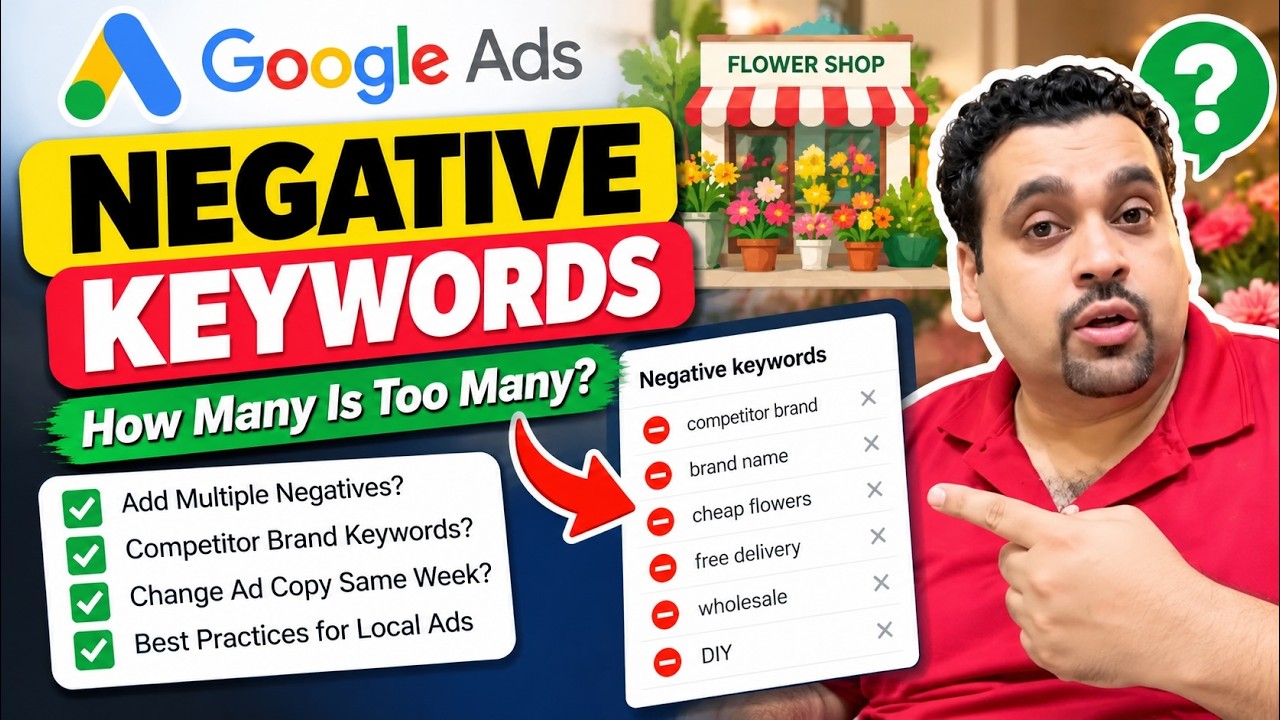
In a recent Q&A, Ali Raza responded to a small brick-and-mortar florist that had launched its first Google Ads Search campaign with help from ChatGPT. Seven days later, the owner spotted competitor brand searches and generic AI-written ads, but worried about disrupting Google’s learning by making changes.
The central question was practical: Can I add negative keywords and improve ad copy in the same week?
In many cases, yes. The better question is whether each change is justified by search intent and backed by a plan to measure results.
What should you optimize in week one?
At AARSWEBS, we assess the quality of a campaign’s inputs before assuming the answer is more budget or a new bid strategy. For a newly launched local Search campaign, the initial review should focus on:
- Search intent: Are real people searching for services the business actually provides?
- Conversion measurement: Is the account recording genuine orders, calls, or enquiries?
- Geographic relevance: Is the targeting aligned with the service area and buying behavior?
- Ad-to-page alignment: Does the promise in the ad match the page customers see?
- Change discipline: Can you explain what was changed, and why?
This is not a promise of quick campaign success. One week of data can be limited. The purpose is to correct obvious misalignment before it consumes more advertising budget.
How many negative keywords should a business add?
There is no fixed weekly quota for negative keywords. Add terms because the search intent is irrelevant, not because you feel a new account needs 20 or 200 exclusions.
For a florist selling fresh arrangements, a search for "paper flower tutorial" is probably irrelevant. A search for "flower shop jobs" may also be unrelated to customer purchases. But a search for "affordable bouquets" could be commercially valuable.
This distinction matters more than list size.
Google Ads’ documented technical limit is 10,000 negative keywords per campaign, with separate limits for shared lists. Marketers also need to consider negative match types and whether an exclusion belongs in one ad group, one campaign, or a shared list.
A poorly chosen exclusion can prevent qualified customers from seeing ads. Copying a large list from another account without checking it can be more damaging than leaving a few uncertain terms under observation.
Read Google’s account limits and negative keyword instructions for the current rules.
A search-term triage method for local businesses
Instead of adding every questionable term to a negative list, give each term one of three labels:
| Search-term group | Recommended next step |
|---|---|
| Clearly unrelated searches | Add a targeted negative after checking the match type. |
| Ambiguous or exploratory searches | Monitor intent and performance; gather more evidence. |
| High-intent local searches | Keep eligible, and consider stronger ads or landing pages. |
This avoids two common mistakes: allowing obvious waste to continue, and excluding valuable traffic prematurely.
For businesses with multiple campaigns, it also helps to maintain a change log and audit shared negative lists. An exclusion created for one product line should not accidentally block another.
What about competitor brand searches?
The florist saw searches for other flower shops, despite not intentionally running a competitor campaign.
For a smaller advertiser, competitor searches can consume budget without producing the same buying intent as category searches such as "order birthday flowers near me." Someone searching for a particular florist may already have decided where to buy.
That is why we generally recommend treating competitor traffic as a separate decision rather than allowing it to blend unnoticed into a general local campaign.
If a business has not chosen to pursue a competitor strategy, excluding specific competitor brand names may improve focus. But competitor traffic is not inherently irrelevant, and the right decision depends on cost, performance, legality of ad claims, and business goals.
Avoid adding broad generic terms as negatives just because they form part of a competitor’s name.
Can negative keywords and responsive search ads be changed together?
Yes, provided there is a reason for each edit.
For example, the advertiser might exclude clearly unrelated DIY flower searches and rewrite a vague headline from "Best Flowers" to something more informative such as "Fresh Bouquets in [City]."
Both changes can improve the match between an ad and a genuine customer request.
Google’s Smart Bidding learning guidance explains that editing creatives does not, on its own, trigger a new "Learning" status or erase prior historical data. Edited ads still undergo the normal review process.
However, advertisers should not interpret this as permission to change conversion goals, bidding objectives, campaign structure, or budget strategy every day. Frequent unplanned edits can make performance diagnosis harder.
Location targeting is more than selecting ZIP codes
A local florist may deliver only within a few ZIP codes, yet receive legitimate orders from people outside those areas buying gifts for local recipients.
That makes the distinction between Google’s Presence and Presence or Interest targeting important. The appropriate setting depends on whether the business requires the shopper to be local or only the delivery destination to be local.
Review the campaign’s location options, actual service area, and geographic performance data. Location targeting is approximate and should be measured rather than assumed perfect.
See Google’s location targeting options.
An ad audit should connect copy, landing page and conversion tracking
AI can help draft a campaign, but generic copy rarely explains a local business’s real advantages.
Useful messaging might communicate:
- The type of bouquets or arrangements offered.
- Verified delivery or pickup options.
- The actual service location.
- A specific reason to trust the shop.
- A clear next step to order or enquire.
Each claim must be true and supported on the landing page.
An ad promising birthday bouquets should send users to a suitable product or service page. The conversion setup should measure real purchases or qualified enquiries, not simply page views.
At AARSWEBS, these checks are part of a wider Google Ads management approach: traffic quality, conversion accuracy, landing-page behavior, and the business value of leads and sales.
A practical seven-day audit checklist
Before deciding a new campaign is underperforming—or making large structural changes—review:
- Search terms: Identify repeated irrelevant themes and their costs.
- Negative lists: Check campaign scope, match types, and accidental conflicts.
- Competitor searches: Separate them from nonbrand local purchase intent.
- Conversion actions: Verify real purchase, call, and lead tracking.
- Geography: Confirm the settings reflect how customers buy.
- Responsive Search Ads: Replace generic wording with accurate selling points.
- Landing pages: Align offers, products, and calls to action.
- Change history: Record improvements so their effects can be assessed.
You can also read Ali Raza’s Google Ads optimization guide on AliRaza.co for the educational perspective behind the video.
Need a second opinion on wasted Google Ads spend?
A campaign can attract traffic and still fail to produce qualified enquiries or sales. If your account has unexplained search terms, low-quality leads, unreliable conversion tracking, or ads that do not match your landing pages, the priority is a careful diagnosis.
Request a free Google Ads audit from AARSWEBS to discuss the account’s setup, tracking, and improvement opportunities. You can also review our Google Ads management approach.
The audit is a diagnostic starting point; ad performance and outcomes vary by account. Our team will explain the findings and agree on any paid implementation scope before work begins.